The Attrition Thesis: Five Thousand Years of Statecraft, Technology and Power, and What History Predicts for the Race in Artificial Intelligence and Robotics
Version 1.0 | September 2026
Empires & Engines: The Nation as Enterprise
The Attrition Thesis: Five Thousand Years of Statecraft, Technology and Power, and What History Predicts for the Race in Artificial Intelligence and Robotics
Version 1.0 | Published 24 September 2026 | Data current to September 2026
Suggested citation: Empires & Engines (2026). The Nation as Enterprise: The Attrition Thesis. Version 1.0, September 2026.
Important notice. This paper is for educational and informational purposes only. It is not investment, legal or financial advice, and nothing in it is a recommendation to buy or sell any security. Figures are drawn from the public sources cited in the text and appendices; where sources disagree, ranges are given. Estimates, scenarios and probabilities labeled as Empires & Engines judgments are the authors’ views, not forecasts by any cited institution. Market data, conflict data and policy measures change quickly; readers should verify current figures before relying on them. References to companies, institutions and public figures do not imply their endorsement. All charts and infographics were created by Empires & Engines from the cited sources.
© 2026 Empires & Engines. All rights reserved. Short excerpts may be quoted with attribution and a link to the original.
“The winner at the end of the day is whoever can withstand attrition the longest and produce the most the longest, through having the best supply chain, the most efficient production capabilities and the best technology. And if humans are your highest cost of capital, since they are also one of your resources, then the race to efficiency necessitates a huge output of robotics: essentially drone wars in multiple capacities, whether in research, war, transportation or beyond. The future is now. We live in the future. Mankind needs robots.”
This thesis is the spine of the entire paper. Every chapter ends with a Thesis Link that connects its history to the three pillars of endurance (supply chain, efficient production and technology) and to the case for robots at scale. Chapters 16 to 23 test the thesis against the Russia-Ukraine war, the power race, the shipbuilding gap, Taiwan, the middle powers, the magnet chokepoint, jobs and space, and Chapter 24 tests it directly, including its strongest objections.
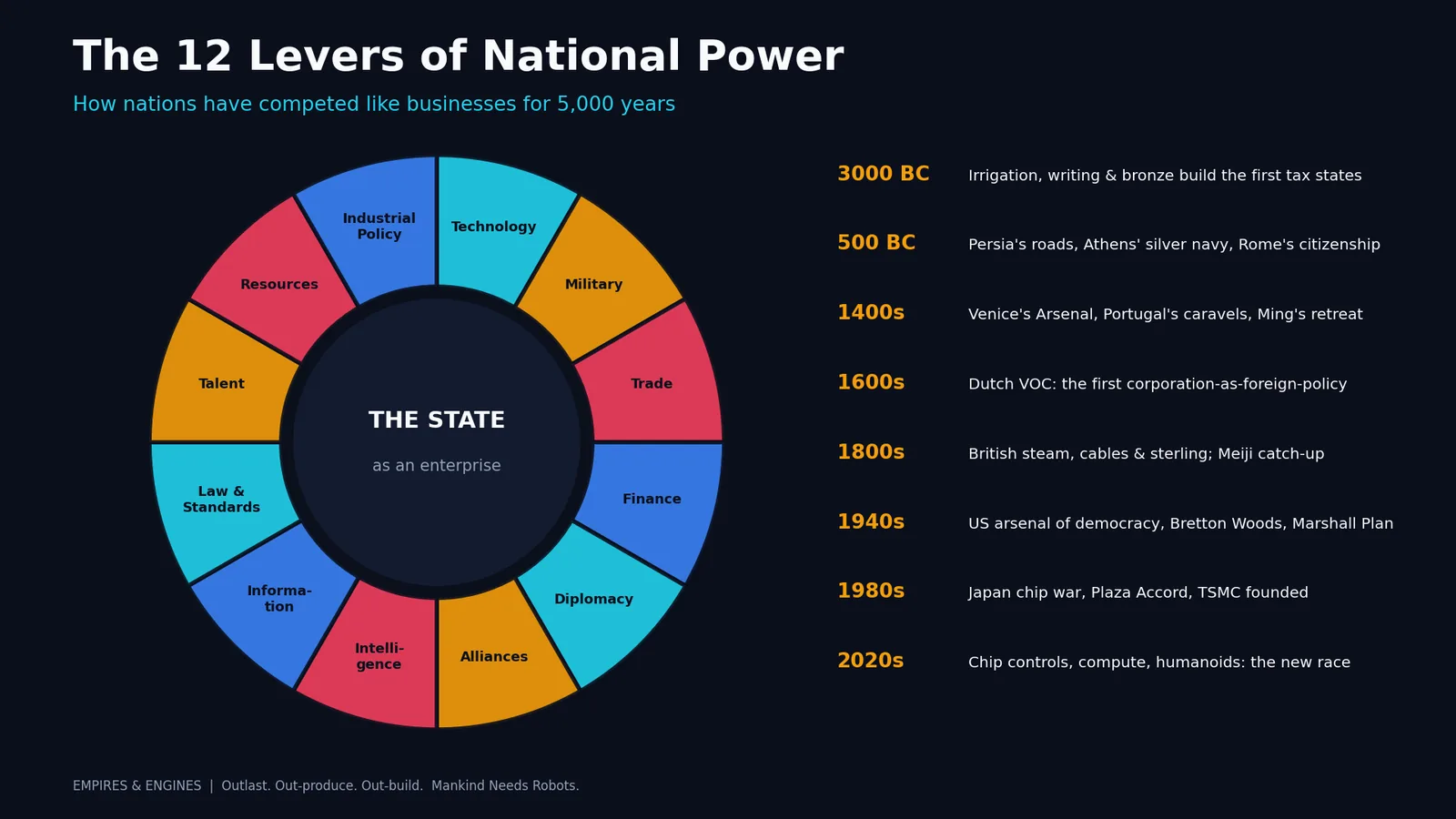
This thesis argues that nations have always behaved like enterprises. They generate revenue, sell products, recruit talent, finance expansion, form joint ventures, acquire rivals and try to put competitors out of business. The names change (tribute becomes taxation, conquest becomes acquisition, alliance becomes joint venture, blockade becomes sanction, espionage becomes technology transfer) but the underlying logic has been stable for five thousand years. Drawing on case studies from Sumer to Silicon Valley, the paper builds a framework of twelve levers of national power: technology, military force, trade, finance, diplomacy, alliances, intelligence, information, law and standards, talent, resources, and industrial policy. It then extracts twelve recurring laws from the historical record, examines the failure modes of great powers that mismanaged their levers, and applies the entire framework to the defining contest of the twenty-first century: the race between the United States, China and their partners for leadership in artificial intelligence, robotics and humanoid machines.
The central finding is that the AI and robotics race is not a new kind of competition. It is the oldest kind, played with new equipment. Compute has become what coal was to Victorian Britain, chip fabrication plays the role that the Strait of Malacca played for the Portuguese, robot fleets are becoming what steel tonnage was in 1900, and export controls on semiconductors echo the eighteenth-century British bans on exporting textile machinery. History does not tell us who will win. It does tell us which variables decide winners, how quickly technological monopolies erode, and which mistakes leading powers repeatedly make. Those patterns are the foundation of this paper and of the Empires & Engines video series built on it.
0. The attrition thesis. The winner is whoever can withstand attrition longest and produce the most for longest, through the best supply chain, the most efficient production and the best technology. Because humans are both the largest cost and a finite resource, sustained output in this century requires robots at massive scale. Mankind needs robots. A wartime head of state has now said it outright: at the UN General Assembly on 23 September 2026, Zelensky defined Ukraine’s target as “Russia’s finances and Russia’s production,” the capacity to sustain the war.
1. States are firms with armies. Every durable state has had a revenue model (taxes, tariffs, tribute, rents, seigniorage), a product line (security, currency, law, market access, citizenship), a customer base (citizens, allies, trading partners, investors) and competitors. Thinking of countries this way explains behavior that looks irrational through a purely military or ideological lens.
2. Twelve levers explain almost all national strategy. Technology, military force, trade, finance, diplomacy, alliances, intelligence, information, law and standards, talent, resources and industrial policy. Great powers win by combining levers, not by excelling at one. Rome combined roads, law and citizenship. Britain combined the Royal Navy, the Bank of England, the telegraph cable network and sterling. The United States combined mass production, the dollar, alliances and universities.
3. Every lever has an offensive twin. The same instruments used to strengthen oneself are used to weaken rivals: blockades, embargoes, sanctions, export controls, currency pressure, talent poaching, subversion, proxy war and cost imposition. The Megarian Decree of ancient Athens and the US semiconductor controls of 2022 are the same move separated by 2,450 years.
4. Technology monopolies are temporary, and the half-life is shrinking. Byzantium kept Greek fire secret for centuries. Britain’s ban on exporting textile machinery held for decades before Samuel Slater carried the designs to America in his head. The Soviet Union tested an atomic bomb four years after Hiroshima. In January 2025, China’s DeepSeek matched leading US reasoning models within months. By March 2026, Stanford’s AI Index measured the gap between the best American and Chinese models at just 2.7 percent.
5. Chokepoints capture rents. Portugal seized Hormuz, Goa and Malacca; Britain controlled the world’s undersea cables; the United States controls dollar clearing. Today’s chokepoints are extreme ultraviolet lithography, leading-edge foundries, advanced chips, rare-earth magnets and electrical power.
6. The catch-up playbook is repeatable. Copy, protect, scale, export, then innovate. The United States ran it against Britain, Germany and Japan ran it against both, Korea and Taiwan ran it against Japan, and China is running it against everyone. Each time, the incumbent called it theft, and each time it worked.
7. In AI and robotics, the race is split. The United States leads in capital, frontier models, compute and data centers. China leads in industrial robots, patents, manufacturing scale and humanoid shipments. Neither lead is safe. History suggests the decisive variables will be energy, supply-chain control, talent flows, alliance breadth and the speed at which each system converts invention into deployment.
The Robot Race Tracker applies this paper's framework to live data: humanoid shipments, the US vs China scorecard, chokepoint alerts and dated forecasts. The Race Report brings the update to your inbox.
Part I builds the framework: why states behave like enterprises, the twelve levers, and the analytical method. Part II walks through history chronologically, treating each era as a set of case studies. Each case ends with a short “Lever Lesson” that connects the episode to the framework. Part III synthesizes the laws and the failure modes. Part IV applies everything to artificial intelligence, robotics and humanoids, with scenarios to 2050 and indicators to track. Part V tests the thesis against the live contests of 2025 and 2026 and closes with the attrition thesis in full. The appendices contain a master timeline, a lever-by-era matrix, a glossary and a bibliography.
The paper is also the research foundation for the Empires & Engines video series. Chapters are self-contained, examples are chosen for narrative power, and every chapter ends with a bridge to the present-day technology race.
Political scientists describe states in terms of sovereignty, legitimacy and the monopoly of violence. Those descriptions are correct but incomplete. They explain what a state is, not what it does every day. What states do every day is closer to what companies do: they raise money, allocate capital, compete for customers, defend market share, hire talent, manage suppliers and try to lower their costs relative to rivals.
The comparison is not a metaphor invented by modern consultants. It is embedded in history. The Dutch East India Company (VOC), founded in 1602, was a private company that could raise armies, wage war, sign treaties and mint coins. The British East India Company governed much of the Indian subcontinent for a century. Venice was run by a council of merchant families who treated foreign policy as an extension of their shipping business. Carthage was a trading republic whose wars were fought largely by hired mercenaries, paid out of commercial profits. The line between state and enterprise has always been blurry.
Every durable state answers the same questions a business must answer.
| Business concept | State equivalent | Historical example |
|---|---|---|
| Revenue | Taxes, tariffs, tribute, resource rents, seigniorage | Egyptian grain tax set by Nile flood levels |
| Product | Security, currency, law, citizenship, market access | Roman citizenship as a premium membership |
| Customers | Citizens, allies, trading partners, investors | Delian League members paying for Athenian protection |
| Competitors | Rival states and empires | Rome vs Carthage; US vs USSR |
| Capital raising | Bonds, central banks, tribute, plunder | Bank of England (1694) funding British wars |
| R&D | Science academies, arsenals, labs, universities | Venetian Arsenal; DARPA; Bell Labs |
| Human resources | Education, immigration, talent recruitment | Operation Paperclip; Meiji-era foreign experts |
| Supply chain | Resources, trade routes, chokepoints | Portuguese control of the Strait of Malacca |
| Mergers and acquisitions | Conquest, dynastic marriage, purchase | Louisiana Purchase (1803); Habsburg marriages |
| Joint ventures | Alliances and trade blocs | Hanseatic League; NATO; the Zollverein |
| Brand | Legitimacy, prestige, soft power | Pax Romana; the “American Dream” |
| Moat | Geography, network effects, standards | The dollar’s reserve-currency status |
When a state executes this model well, it grows richer and more powerful than rivals with more people or more land. The Dutch Republic of the seventeenth century had perhaps two million people, yet dominated world trade. Britain, an island of modest size, ran the largest empire in history. Singapore, with no natural resources, built one of the highest per-capita incomes on Earth.
Companies pursue three strategies at once: grow their own business, defend their position, and weaken competitors. States do the same.
Growth means raising productivity and revenue: better technology, bigger markets, more trade, more skilled people, cheaper capital.
Defense means protecting what exists: armies and navies, fortifications, tariffs to protect infant industries, secrecy around key technologies, alliances that deter attack.
Offense means reducing the rival’s capacity: blockades and sanctions that starve its revenue, export controls that deny it technology, subversion that weakens it from within, alliances that encircle it, and arms races that force it to spend more than it can afford.
The most successful states have managed all three simultaneously. The least successful have over-invested in one, usually military offense, and neglected the revenue base that pays for everything else.
Viewed through this lens, the US-China technology race stops looking like a clash of ideologies and starts looking like a contest between two very large conglomerates with different business models. The American model is capital-market driven: private investors put US$285.9 billion into AI in 2025, according to the Stanford AI Index, roughly 23 times China’s tracked private total. The Chinese model is state-directed and manufacturing-led: China installed 295,000 industrial robots in 2024, 54 percent of the world total, according to the International Federation of Robotics, and Chinese companies shipped the large majority of the world’s humanoid robots in 2025. Each model has advantages the other cannot easily copy. The rest of this paper explains why history suggests those differences matter.
Thesis Link: A state is a production enterprise. Its revenue, and therefore its endurance, depends on how much it can produce and for how long.
Military planners in the United States often use the acronym DIME (diplomatic, informational, military, economic) or its extended form DIMEFIL (adding financial, intelligence and law enforcement). This paper expands and reorganizes those categories into twelve levers that better capture how states have competed across all of recorded history. Each lever has a constructive use (strengthening oneself) and an offensive use (weakening a rival).
Constructive: invention, adoption and diffusion of productive and military technologies. Irrigation, iron, the stirrup, gunpowder, the printing press, the steam engine, electricity, the transistor, the neural network.
Offensive: secrecy, export bans, sabotage and denial of access. Byzantine secrecy around Greek fire; British bans on exporting textile machinery; modern semiconductor export controls.
Constructive: deterrence and protection of trade routes, territory and allies. The Royal Navy protecting British commerce; the US Navy guaranteeing freedom of navigation.
Offensive: conquest, raids, blockade and destruction of a rival’s productive capacity. Rome’s destruction of Carthage in 146 BC; the Allied bombing campaigns against German industry in 1943 to 1945.
Constructive: access to larger markets, specialization and cheaper inputs. The Silk Road; the British free-trade era after 1846; China’s entry into the World Trade Organization in 2001.
Offensive: embargoes, tariffs, boycotts and the manipulation of dependence. The Hanseatic embargo of Norway in 1284; the Arab oil embargo of 1973; China’s 2010 restriction of rare-earth exports to Japan.
Constructive: cheap and reliable capital for the state and its firms. The Bank of Amsterdam (1609); the Bank of England (1694); the dollar-centered Bretton Woods system (1944).
Offensive: sanctions, currency pressure, debt leverage and exclusion from payment systems. US pressure on sterling during the Suez Crisis of 1956; the freezing of Russian central bank reserves in 2022.
Constructive: negotiated peace, favorable treaties, arbitration and prestige. The Treaty of Tordesillas (1494); the Congress of Vienna (1815).
Offensive: isolating rivals, dividing coalitions and negotiating from strength. Bismarck’s alliance system designed to keep France isolated after 1871.
Constructive: pooling power, sharing costs and accessing allies’ technology. The Delian League; the Anglo-Japanese Alliance (1902); NATO (1949).
Offensive: encirclement, containment and the recruitment of a rival’s neighbors. Han China’s search for allies against the Xiongnu; US containment of the Soviet Union.
Constructive: knowing rivals’ capabilities and intentions; acquiring their technology. Venetian ambassadorial reports; British code-breaking at Bletchley Park.
Offensive: espionage, theft of technology and covert action. The smuggling of silkworm eggs to Byzantium around 552 AD; Soviet atomic espionage in the 1940s.
Constructive: narrative, prestige, culture and soft power. Roman monuments, American cinema, Korean pop culture.
Offensive: propaganda, censorship, control of communications infrastructure. Britain’s severing of Germany’s undersea telegraph cables in August 1914.
Constructive: predictable rules that lower transaction costs; standards that create network effects. Hammurabi’s code; Qin standardization of weights, measures and axle widths; the metric system; international technical standards.
Offensive: using rules and standards to lock rivals out. The Navigation Acts (1651) excluded Dutch ships from English trade; modern “entity lists” exclude named firms from supply chains.
Constructive: education, immigration and the recruitment of skilled people. Land-grant universities in the United States (1862); Meiji Japan’s hiring of foreign experts.
Offensive: poaching, brain drain and restrictions on a rival’s access to skilled people. Operation Paperclip brought more than 1,600 German scientists to the United States after 1945.
Constructive: securing food, energy, metals and land. Egyptian grain for Rome; British coal; American oil; Chinese rare-earth processing.
Offensive: denying resources to rivals or weaponizing dependence. The British blockade of Germany in the First World War; Russian gas supplies to Europe before 2022.
Constructive: state direction of capital toward strategic industries. Colbert’s royal manufactures; Hamilton’s Report on Manufactures (1791); Japan’s Ministry of International Trade and Industry; “Made in China 2025.”
Offensive: subsidizing domestic champions to capture global market share and drive foreign competitors out. Critics accuse China of doing this in steel, solar panels, batteries and electric vehicles; China’s critics say the United States is now doing it in semiconductors.
No great power has relied on a single lever. Levers compound: finance pays for military force, military force protects trade, trade funds technology, technology improves military force, and alliances multiply all of them. The most important strategic question for any state is not “which lever is strongest?” but “which combination of levers creates a self-reinforcing loop?” Britain’s loop in the eighteenth and nineteenth centuries (trade funded the navy, the navy protected trade, the Bank of England financed both at low interest rates) is the classic example. America’s post-1945 loop (alliances created markets, markets strengthened the dollar, the dollar funded defense, defense secured the alliances) is the modern one. China’s loop since 2001 (exports funded industrial investment, industrial investment built supply chains, supply chains attracted more exports, and state finance underwrote the whole system) is the challenger’s version.
Thesis Link: Supply chain (resources, trade), efficient production (industrial policy, talent) and technology are the three levers the attrition thesis says a winner must combine.
This paper was built using twelve thinking modes, each chosen to counter a specific bias that distorts analysis of geopolitics and technology.
Divergent thinking was used to generate the widest possible set of historical cases before narrowing, covering the Near East, Mediterranean, South Asia, East Asia, Europe and the Americas rather than only the familiar Western canon.
Convergent thinking was used to reduce hundreds of cases to the twelve levers and twelve laws that recur most consistently.
Lateral thinking was used to find non-obvious analogies: Byzantine silk espionage as a precedent for AI model-weight theft, or the Venetian Arsenal as a precedent for Tesla’s conversion of its Fremont car line to humanoid production.
Systemic thinking treated each state as a system of interacting levers rather than a list of isolated decisions.
Associative thinking linked episodes across eras that share structure, such as the Megarian Decree, the Continental System and modern semiconductor controls, all of them attempts to strangle a rival’s trade.
Critical thinking tested popular narratives against evidence, for instance the claim that the Ming dynasty’s retreat from the sea was purely ideological.
Analytical thinking broke outcomes into measurable components: revenue, productivity, population, capital cost and military capability.
Abductive thinking asked for the best available explanation where evidence is incomplete, such as why Britain rather than China or the Netherlands industrialized first.
First-principles thinking reduced national power to its irreducible inputs: energy, people, capital, knowledge and organization.
Second-order thinking asked what happens after the first effect. Export controls slow a rival in the short run but can accelerate its domestic substitution in the long run.
Janusian thinking held opposites together: technology both centralizes and decentralizes power; openness both exposes secrets and attracts talent.
Metacognitive thinking checked the paper’s own biases, particularly hindsight bias and the tendency to treat the eventual winner as inevitable.
The same twelve lenses are used in the Empires & Engines market research on robotics and AI, so that the historical and contemporary analyses share one method.
Thesis Link: Every lens in this method is pointed at one question: which system can sustain the highest output for the longest time?
The first great information technology in history was invented for accounting. In the cities of Sumer in southern Mesopotamia, clay tokens and then inscribed tablets emerged in the fourth millennium BC to record grain, livestock, labor and obligations owed to temples and rulers. Cuneiform writing, which developed in Uruk around 3200 BC, was at first overwhelmingly administrative. It allowed a small elite to track surpluses produced by thousands of farmers working irrigated fields.
That combination, irrigation to raise output plus writing to capture a share of it, is the prototype of the fiscal state. Irrigation was a productivity technology. Writing was a revenue technology. Together they allowed Sumerian cities to support specialists: priests, scribes, soldiers, metalworkers and merchants. The cities then competed with one another for water rights, trade routes and tribute, and the first recorded border war in history, between Lagash and Umma, was fought over irrigated land.
A few centuries later, Hammurabi of Babylon (reigned c. 1792 to 1750 BC) carved a code of 282 laws onto stone and placed copies in public view. The code regulated contracts, loans, wages, property and trade. It is usually taught as a legal milestone, but it was equally an economic instrument. Predictable rules lowered the cost of doing business across a large territory, which increased trade and therefore the ruler’s revenue.
Lever Lesson: Technology (irrigation), information (writing) and law (standardized rules) formed the first self-reinforcing loop of state power. Every state since has needed some version of the same loop: produce more, measure it, and set rules that make exchange cheap.
Ancient Egypt was, in business terms, a vertically integrated grain monopoly with a divine CEO. The Nile’s annual flood deposited fertile silt, and the state measured the flood with Nilometers, graduated stone structures that recorded the river’s height. Officials used those readings to forecast the harvest and set taxes accordingly. It is one of the earliest examples of data-driven revenue management.
Egypt’s surplus funded the pyramids, the temples and the army, but it also made Egypt a target. Nearly every major empire of the ancient Mediterranean, from Persia to Macedon to Rome, sought control of Egyptian grain. When Rome annexed Egypt in 30 BC, Egyptian wheat became a pillar of the grain supply that fed the city of Rome, and whoever controlled that supply held a lever over the capital’s stability.
Lever Lesson: Resource surpluses create power, but they also create dependency and attract predators. Egypt’s grain is the ancient equivalent of Gulf oil, Taiwanese chips or Chinese rare earths.
Bronze requires copper and tin, and in the Late Bronze Age the two metals were rarely found in the same place. Tin had to travel long distances along trade networks linking Afghanistan, Anatolia, Cyprus, the Levant and the Aegean. The great palace economies of the Hittites, Mycenaeans, Egyptians and Babylonians were bound together by this trade, by diplomatic marriages and by a sophisticated system of royal correspondence preserved in the Amarna letters.
Around 1200 to 1150 BC, this interlocking system collapsed. Historians still debate the causes: drought, earthquakes, internal revolts, the raiders known as the Sea Peoples, and the breakdown of trade. The most persuasive explanation is systemic. Many shocks hit a tightly coupled network at once, and because each state depended on the others, failure cascaded. Several civilizations lost literacy for centuries.
Lever Lesson: Deep interdependence raises prosperity in good times and multiplies fragility in bad times. Modern semiconductor supply chains, which cross dozens of borders before a finished chip reaches a robot, carry the same systemic risk.
The Neo-Assyrian Empire (c. 911 to 609 BC) pioneered the standing professional army, iron weapons at scale, siege engineering and a relay messaging system that let the king communicate across his territory. It also practiced mass deportation to break the cohesion of conquered peoples. The empire expanded fast and then collapsed fast, in part because it relied on terror and extraction rather than loyalty.
The Achaemenid Persian Empire that followed, founded by Cyrus the Great around 550 BC, ran a different business model. Cyrus and his successors allowed conquered peoples to keep their religions, languages and local elites, provided they paid tribute and supplied troops. Darius I (reigned 522 to 486 BC) divided the empire into provinces called satrapies, each with a fixed tribute obligation, standardized weights and measures, and introduced the gold daric coin. The Royal Road, roughly 2,700 kilometers from Sardis in Anatolia to Susa in Persia, allowed royal couriers using relay stations to cover the distance in about a week, according to Herodotus.
Persia also inherited a monetary innovation from its conquest of Lydia. The Lydians, in western Anatolia, are credited with minting the first coins, of electrum, in the seventh century BC. Coinage was a financial technology of enormous importance. It reduced the cost of paying soldiers, collecting taxes and conducting trade.
Lever Lesson: Persia shows the difference between extraction and management. Tolerance, standardized administration, reliable money and fast communication allowed a relatively small Persian elite to run the largest empire the world had yet seen. Customer retention, in business language, was cheaper than constant reconquest.
In 483 BC, miners at Laurion near Athens struck a rich new vein of silver. The assembly debated distributing the windfall to citizens. The statesman Themistocles persuaded them instead to build a fleet of warships, about 200 triremes. Three years later, in 480 BC, that fleet defeated the Persian navy at Salamis. It may be the most consequential public investment decision in Western history.
After the Persian Wars, Athens organized the Delian League (478 BC), an alliance of Aegean city-states contributing ships or money to a common defense. Over time most members paid money rather than ships, and Athens built and crewed the fleet. In 454 BC the league treasury was moved from the island of Delos to Athens. The alliance had become an Athenian protection business: members paid, Athens provided security, and Athens also used the funds for its own purposes, including the building program on the Acropolis. Members that tried to leave, such as Naxos and Thasos, were forced back.
Athens also used trade as a weapon. The Megarian Decree, around 432 BC, barred the merchants of Megara, an ally of Sparta, from the harbors of the Athenian empire and the Athenian marketplace. Thucydides records it as one of the grievances that led to the Peloponnesian War (431 to 404 BC). It is among the earliest recorded economic sanctions.
Athens lost that war. Sparta, a land power with a very different system, eventually won with Persian money that paid for a Spartan fleet, a reminder that finance can buy the one capability a rival thought was unmatchable.
Lever Lesson: Athens converted a resource windfall into technology (triremes), used technology to build an alliance, turned the alliance into a revenue stream, and used trade exclusion as a weapon. It then overreached, and a rival bought its way into naval parity. Every element of that story reappears in later eras.
Philip II of Macedon (reigned 359 to 336 BC) transformed a backward kingdom into the dominant power in Greece. He reorganized the army around the sarissa, a pike of roughly five to six meters, which gave the Macedonian phalanx reach over conventional Greek hoplites. He professionalized the cavalry, invested in siege engineering, and exploited the gold mines of Mount Pangaion.
Just as important, Philip used money as a weapon. Ancient writers attributed to him the saying that no fortress was impregnable if a donkey laden with gold could be brought up to it. He bribed politicians in rival cities, split coalitions and bought time when he needed it. His son Alexander used the resulting machine to conquer the Persian Empire between 334 and 323 BC.
Lever Lesson: Military technology wins battles, but finance and intelligence decide which battles need to be fought at all. Philip was an early master of combining levers.
In India, the Arthashastra, a treatise on statecraft traditionally attributed to Kautilya (also called Chanakya), adviser to Chandragupta Maurya around the late fourth century BC, set out a remarkably modern theory of interstate competition. Its mandala theory describes concentric circles of states: one’s immediate neighbor is a natural enemy, and the neighbor’s neighbor is a natural friend. The text lists six measures of foreign policy: peace, war, neutrality, preparing to march, seeking alliance, and the double policy of making peace with one state while waging war on another. It also devotes extensive attention to espionage, taxation, state enterprises in mining and trade, and the management of the treasury.
Lever Lesson: The idea that “the enemy of my enemy is my friend” was written down more than two thousand years ago. Modern alliance structures in the Indo-Pacific, where neighbors of China seek partnership with distant powers, follow the mandala logic almost exactly.
Rome was not the most technologically advanced society of its time in every field, and it was not the richest at the start. It became dominant because it built a platform that others wanted to join.
Citizenship as a product. Rome extended graduated forms of citizenship to allies and conquered peoples, offering legal protections, trade rights and a path to full membership. After the Social War (91 to 88 BC), in which Italian allies fought for citizenship, it was extended across Italy. In 212 AD the emperor Caracalla extended citizenship to nearly all free inhabitants of the empire. The ancient historian Cassius Dio suggested one motive was to widen the tax base, because certain taxes, including an inheritance tax, fell on citizens. Citizenship was, in effect, a membership program that also expanded revenue.
Infrastructure as a moat. Rome built tens of thousands of kilometers of paved roads, along with aqueducts, bridges and ports. Roads moved legions quickly, but they also lowered trade costs and bound provinces economically to the center.
Copying the competitor. At the start of the First Punic War (264 to 241 BC), Rome was a land power facing Carthage, the leading naval power of the western Mediterranean. According to Polybius, the Romans used a stranded Carthaginian warship as a model and built a fleet in a matter of months. They added their own innovation, the corvus, a boarding bridge that let Roman infantry fight at sea as if on land. Rome won the war. The episode is the ancient template for the fast follower: reverse-engineer the leader’s technology, then adapt it to your own strengths.
Divide and rule. Rome dealt with neighbors one at a time, signed separate treaties with each, rewarded loyal allies and punished defectors, and used client kings as buffers. The principle later summarized as divide et impera allowed Rome to avoid fighting coalitions.
Destroying the rival. After the Second Punic War, Rome imposed an enormous indemnity on Carthage and restricted its right to make war. When Carthage recovered commercially anyway, Rome destroyed the city in 146 BC. Cato the Elder had reportedly ended his speeches with the demand that Carthage be destroyed. It was the ancient world’s clearest example of eliminating a commercial competitor by force.
Debasement and decline. In the third century AD, emperors financed wars and payrolls by reducing the silver content of the denarius, eventually to a small fraction of its earlier level. Prices rose, trust in money collapsed and the state increasingly collected taxes in kind. Monetary debasement was a symptom and an accelerant of the crisis that nearly destroyed the empire.
Lever Lesson: Rome’s durable advantages came from law, infrastructure and inclusion, the platform, not from any single weapon. Its decline began when it could no longer pay for its commitments and resorted to debasing its currency. Both lessons apply directly to modern superpowers.
In 221 BC, the state of Qin unified China after centuries of warfare. Its success rested on reforms associated with the Legalist statesman Shang Yang in the fourth century BC: rewards and ranks based on military and agricultural output rather than birth, strict laws and a centralized bureaucracy. After unification, the First Emperor standardized the written script, weights, measures, currency and even axle widths, so that carts could use the same road ruts across the empire. Standardization was a unifying technology as powerful as any weapon.
The Han dynasty (206 BC to 220 AD) built on this foundation. Under Emperor Wu (reigned 141 to 87 BC), the state established monopolies over salt and iron to finance wars against the Xiongnu confederation on the northern steppe. In 81 BC the court held a famous debate, later recorded as the Discourses on Salt and Iron, in which officials defended the monopolies as necessary for national security and Confucian scholars attacked them as harmful to the people. It is one of the earliest recorded debates about industrial policy, and its arguments are nearly identical to modern ones about state-owned enterprises.
Han diplomacy was equally sophisticated. Early Han rulers used the heqin policy, sending princesses in marriage and annual gifts to the Xiongnu in exchange for peace, a form of paying tribute to buy time. Emperor Wu later reversed course. In 138 BC he sent the envoy Zhang Qian westward to find allies against the Xiongnu. Zhang Qian was captured and held for years, but his journeys opened Chinese knowledge of Central Asia and helped lay the foundations of the trade routes later called the Silk Road. China exported silk, and the secret of sericulture was guarded carefully.
Over later centuries, China developed a tributary system in which neighboring rulers sent envoys bearing gifts and acknowledged the emperor’s formal supremacy, and in return received trade privileges and often more valuable gifts. It was part diplomacy, part trade regime and part prestige product.
Lever Lesson: China’s early empires show the power of standards, the long history of state monopolies in strategic industries, and the use of both tribute and alliances to manage rivals. The Discourses on Salt and Iron could be replayed today, word for word, as a debate over subsidies for chips and robots.
The ancient world already contains every lever this paper describes. Sumer shows that information technology begins as revenue technology; today, data is harvested by platforms and taxed by states. Athens shows that alliances can become revenue streams; today, security guarantees are bundled with arms sales and technology access. Rome shows that the fast follower can overtake the leader by copying and adapting; China’s rise in electric vehicles and robots follows the same pattern. Qin shows that standards unify markets; today, whoever writes the safety and interoperability standards for humanoid robots will shape the global market. And Han China shows that the debate over state-led industrial policy is more than two thousand years old. > Thesis Link: Rome beat Carthage by rebuilding fleet after fleet. The ancient world already rewarded the side that could absorb losses and keep producing.
The Eastern Roman Empire, known to historians as Byzantium, survived for roughly a thousand years after the fall of the western empire in 476. It did so with fewer soldiers than its rivals, and it compensated with four levers: technology secrecy, financial strength, diplomacy and intelligence.
Industrial espionage. Around 552 AD, according to the historian Procopius, monks smuggled silkworm eggs out of Central Asia to Constantinople, reportedly hidden in hollow canes, at the request of Emperor Justinian. This broke a lucrative monopoly and allowed Byzantium to build its own silk industry, which became a state-controlled source of revenue and diplomatic gifts. It is one of the earliest well-documented cases of technology theft as state policy.
A secret weapon. In the 670s, Byzantine forces began using “Greek fire,” an incendiary liquid projected from siphons on ships that continued burning on water. It helped break Arab sieges of Constantinople. Its exact formula was so closely guarded that it is still debated today. Byzantium restricted knowledge of the weapon to a small group, and the secret was eventually lost.
Sound money. The gold solidus, introduced by Constantine the Great in the early fourth century, kept its weight and purity for roughly seven centuries. It became a trusted medium of exchange across the Mediterranean and beyond, the dollar of its age. Monetary credibility gave Byzantium access to trade and prestige far beyond its military reach.
Diplomacy as a weapons system. Byzantine emperors paid subsidies to steppe peoples to attack each other, arranged marriages, hosted exiled princes from rival states as future leverage, and dazzled visiting envoys with mechanical thrones and ceremony. A treatise attributed to Emperor Constantine VII in the tenth century, known as De Administrando Imperio, advised his son on how to play neighboring peoples against one another.
Lever Lesson: A state with limited manpower can survive for centuries by combining technology secrecy, credible money and diplomacy that keeps rivals fighting each other. But secrecy is fragile: Byzantium ultimately lost both its silk monopoly’s uniqueness and the formula of Greek fire itself.
The Abbasid Caliphate, centered on Baghdad after 762, became one of the great commercial and intellectual hubs in history. Muslim traders connected the Mediterranean, the Indian Ocean, East Africa and Central Asia. The gold dinar and silver dirham circulated widely, and merchants developed credit instruments such as the sakk, a written payment order.
Papermaking spread westward from China into the Islamic world in the eighth century, traditionally linked to Chinese prisoners taken after the Battle of Talas in 751, and a paper mill was reported in Baghdad by the 790s. Cheap paper transformed administration, scholarship and commerce. In Baghdad, scholars associated with the House of Wisdom translated Greek, Persian and Indian works into Arabic and extended them in mathematics, astronomy and medicine. The word “algorithm” derives from the name of the ninth-century Baghdad mathematician al-Khwarizmi.
Lever Lesson: Openness to foreign knowledge, combined with a cheap information technology (paper) and a common trade language, created a knowledge economy. The pattern is the same one that later made the Netherlands, Britain and the United States centers of innovation: import the world’s ideas and talent, then build on them.
The Song dynasty (960 to 1279) was arguably the most technologically advanced society in the world during its time. It produced movable type (Bi Sheng, eleventh century), widespread use of the magnetic compass for navigation, large-scale iron production, and gunpowder weapons. Merchants in Sichuan issued paper promissory notes called jiaozi, and in the early eleventh century the state took over their issue, creating some of the world’s first government paper money.
Yet the Song faced powerful northern neighbors. Under the Treaty of Chanyuan (1005), the Song agreed to pay the Khitan Liao state annual quantities of silver and silk in exchange for peace. The payments were small relative to Song revenue and far cheaper than war, and the peace lasted over a century. Critics then and since have called it humiliating; defenders note that it was a rational purchase of security by a commercial power. Eventually, the Jurchen Jin conquered northern China in 1127, and the Mongols conquered the Southern Song in 1279.
Lever Lesson: Technological and economic leadership does not guarantee survival if military power and alliance management fall behind. Paying rivals can be efficient, but it works only as long as the payer remains strong enough that the deal is worth keeping.
The Mongol Empire, founded by Genghis Khan in 1206, became the largest contiguous land empire in history. Its armies were mobile and disciplined, but the empire’s reach depended on organization as much as cavalry.
The Mongols built the Yam, a relay network of stations that allowed messengers and officials to cross vast distances quickly. They issued paiza, metal tablets that functioned as passports and authority credentials. They promoted commanders by performance rather than birth. And they systematically recruited skilled people from conquered societies. Chinese and Persian engineers built the siege engines that allowed steppe cavalry to take walled cities. Artisans were often spared from massacres and relocated to serve the empire.
Once conquest was complete, the Mongols protected trade along the Silk Road, producing a period sometimes called the Pax Mongolica in which merchants, diplomats and missionaries traveled between Europe and China. Marco Polo’s journey took place in this environment.
Lever Lesson: The Mongols acquired technology by acquiring the people who held it. Talent acquisition was a military lever. The modern parallel is the global competition for AI researchers and robotics engineers, in which firms and governments recruit individuals because knowledge lives in people, not documents.
Venice was a city-state with a small population and almost no farmland, yet for centuries it was one of the richest powers in Europe. Its secret was that the state functioned as a trading company.
The Venetian Arsenal, a state-owned shipyard, employed thousands of workers and used standardized parts and sequential assembly centuries before Henry Ford. According to a well-known account, during the visit of King Henry III of France in 1574 the Arsenal assembled a galley while the king dined. The state also organized regular armed convoys, called mude, that carried high-value cargo on fixed routes, with space auctioned to merchants. Its ambassadors wrote detailed reports, the relazioni, which formed one of the most sophisticated intelligence systems of the age.
Venice was also ruthless. In 1204, the Fourth Crusade, heavily dependent on Venetian shipping and in debt to Venice, was diverted to Constantinople, which was sacked. Venice gained territory and trade privileges across the eastern Mediterranean. And in 1474, Venice enacted one of the first general patent statutes, granting inventors of new devices exclusive rights for ten years, an early legal tool for attracting and rewarding innovation.
Lever Lesson: Venice fused the state and the enterprise: public manufacturing (the Arsenal), public logistics (the convoys), public intelligence (the ambassadors) and legal innovation (patents). The modern equivalents are state-backed shipbuilders, sovereign wealth funds, industrial policy and intellectual-property law. Tesla converting its Fremont car line into a humanoid-robot assembly line in 2026 is, in spirit, an Arsenal move.
The Hanseatic League was a network of merchant guilds and market towns across northern Europe, anchored by Lübeck, that dominated Baltic and North Sea trade from the thirteenth to the fifteenth centuries. It was not a state, yet it waged war, imposed embargoes and negotiated treaties.
When Norway attacked German merchants in 1284, the Hanseatic towns imposed an embargo that cut off grain supplies, and Norway was forced to concede trading privileges. In 1370, after a war against Denmark, the Treaty of Stralsund gave the Hanseatic towns significant rights and even influence over the Danish succession. The League’s power declined as territorial states grew stronger, new trade routes shifted commerce to the Atlantic, and the Dutch outcompeted Hanseatic shipping.
Lever Lesson: Economic blocs can exercise power without armies by controlling market access. The European Union’s regulatory power in the twenty-first century, including its AI Act, is a descendant of this idea: the market is the weapon.
Between 1405 and 1433, the admiral Zheng He led seven voyages of the Ming treasure fleet across the Indian Ocean to Southeast Asia, India, Arabia and East Africa. The largest fleets numbered hundreds of ships and tens of thousands of men. The voyages projected Ming prestige, enrolled distant rulers in the tributary system and brought back exotic goods, including a giraffe from East Africa.
Then they stopped. Later Ming governments restricted private overseas trade through sea bans, the haijin, and focused resources on the northern frontier, where the Mongol threat remained real. The reasons were complex: cost, court politics, the priority of land defense and the fact that the voyages earned prestige rather than profit. Within a century, Portuguese ships arrived in Chinese waters.
A counterfactual is irresistible. Had the Ming continued, organized its voyages as profit-seeking ventures and allowed private merchants to follow, the history of global trade might have been Chinese rather than European. Critical thinking requires caution: the Ming faced real threats on land, and it was not obvious in 1433 that oceans would matter more than steppes. But the episode remains the classic example of a technological leader choosing to withdraw.
Lever Lesson: Leadership in a technology does not produce power unless it is tied to a revenue model and sustained. The treasure fleets were a demonstration, not a business. Robotics demonstrations that never become paid deployments risk the same fate.
Thesis Link: The Venetian Arsenal was an attrition machine, able to build a galley in a day. Mass production of complex machines is the medieval precedent for the robot gigafactory.
Portugal was a small kingdom on the edge of Europe with limited land and population. In the fifteenth century, under the sponsorship of Prince Henry, often called “the Navigator,” Portuguese sailors systematically explored the African coast, improved the caravel, a nimble ship that could sail closer to the wind, and accumulated navigational knowledge. It was a long-term, state-sponsored research program.
It paid off. Bartolomeu Dias rounded the Cape of Good Hope in 1488, and Vasco da Gama reached India in 1498. The Portuguese then pursued a strategy of controlling chokepoints rather than conquering large territories. Under Afonso de Albuquerque, they seized Goa (1510), Malacca (1511) and Hormuz (1515). From these points they tried to control the spice trade, requiring local ships to buy passes called cartazes in exchange for protection, in effect selling safe passage on routes they could threaten.
Lever Lesson: A small state can capture outsized rents by controlling the narrow points through which trade must pass. In the modern economy, the equivalent chokepoints are not straits but technologies: extreme ultraviolet lithography machines, leading-edge foundries and rare-earth magnet processing.
Spain’s conquests in the Americas brought vast flows of silver, especially after the discovery of the Cerro Rico at Potosí in 1545. For a time, Spain was the richest power in Europe. Yet the Spanish crown defaulted on its debts repeatedly under Philip II, in 1557, 1560, 1575 and 1596, and the empire’s long-term economic development lagged behind that of northern European rivals.
The reasons are widely debated, but the pattern resembles what economists now call the resource curse. Silver inflows financed wars and imports rather than domestic industry. Prices rose across Europe in the so-called price revolution. Spanish manufacturing struggled to compete, and much of the silver flowed through Spain to bankers in Genoa, merchants in the Netherlands and, ultimately, to China, which demanded silver for its goods.
Lever Lesson: Windfall revenue can weaken the productive base of a state if it is used to fund consumption and war rather than capability. It is a warning for any power that relies on a single rent, whether silver, oil or a temporary technological lead.
The Dutch Republic emerged from a revolt against Spain in the late sixteenth century and became, in the seventeenth, the most dynamic economy in Europe. Its population was small, but it combined several innovations.
Shipbuilding technology. The fluyt, a cargo ship developed in the 1590s, carried more goods with a smaller crew than competing designs. Wind-powered sawmills sped up construction. Dutch shipping costs fell below those of rivals, and the Dutch became Europe’s carriers.
Corporate finance. The Dutch East India Company (VOC), chartered in 1602, was the first company to issue permanent, tradable shares to the public. Its shares traded on the Amsterdam exchange, one of the first modern stock markets. The Bank of Amsterdam, founded in 1609, provided a stable money of account for international merchants.
A company with sovereign powers. The VOC could build forts, maintain armies, negotiate treaties and wage war in Asia. It pursued monopoly aggressively and at times brutally. In 1621, to control the nutmeg trade, VOC forces under Jan Pieterszoon Coen conquered the Banda Islands and killed or enslaved much of the population.
Tolerance and talent. The Republic attracted refugees and skilled migrants, including Protestant merchants from Antwerp, Sephardic Jews from Iberia and French Huguenots, who brought capital, trade networks and skills.
Lever Lesson: The Dutch Republic demonstrates that finance, technology and talent can make a small state a great power. It also shows the darker side of merging corporate profit with sovereign force. When modern technology companies begin to command resources on the scale of states (Blackstone’s data center platform alone was valued internally at around US$185 billion in mid-2026), questions about the boundary between company and state return.
Britain’s rise in the eighteenth century was built on a formula that historian John Brewer called the “fiscal-military state.” After the Glorious Revolution of 1688, Parliament controlled taxation and guaranteed the government’s debts. The Bank of England, founded in 1694, managed that debt. Because lenders trusted Parliament, Britain could borrow more cheaply than France, even though France was larger and richer. Cheap borrowing funded the Royal Navy, and the navy protected trade that generated the tax revenue that serviced the debt.
Britain also used law as a weapon. The Navigation Acts, beginning in 1651, required that goods imported into England be carried on English ships or ships of the producing country, directly targeting the Dutch carrying trade. They contributed to three Anglo-Dutch wars between 1652 and 1674.
Innovation policy mattered too. The Statute of Monopolies (1624) limited royal monopolies but preserved patents for genuine new inventions. The Longitude Act of 1714 offered a large prize for a practical method of determining longitude at sea, an early government “challenge prize” that ultimately rewarded John Harrison’s marine chronometers.
Lever Lesson: Credible public finance is a strategic weapon. A state that can borrow cheaply can outspend a larger rival in a long contest. The United States’ ability to fund AI infrastructure through deep capital markets (J.P. Morgan estimated in mid-2026 that AI-related capital expenditure could reach US$5.5 trillion through 2030, with much of it debt-financed) is the modern version of Britain’s advantage.
Jean-Baptiste Colbert, finance minister to Louis XIV from the 1660s until his death in 1683, pursued a deliberate strategy of state-led industrial development. He founded or supported royal manufactures producing tapestries, glass, mirrors and luxury textiles, recruited foreign craftsmen, imposed quality regulations, raised tariffs and built infrastructure including the Canal du Midi, completed in 1681, linking the Atlantic to the Mediterranean. Colbert’s goal was to make France self-sufficient in high-value goods and to accumulate bullion through trade surpluses.
Colbertism produced real achievements, and French luxury industries remain world leaders centuries later. But the policy was undermined by Louis XIV’s constant wars and, in 1685, by the revocation of the Edict of Nantes, which ended toleration of Protestants. Perhaps two hundred thousand Huguenots fled France, many of them skilled artisans and merchants, strengthening England, the Netherlands and Prussia.
Lever Lesson: Industrial policy can build capabilities, but it cannot survive policies that drive away talent. The Huguenot exodus is history’s clearest example of a state handing its human capital to its competitors. The Stanford AI Index’s 2026 finding that AI researchers relocating to the United States have fallen 89 percent since 2017 is a warning in the same category.
In the early seventeenth century, Japan’s Tokugawa shogunate restricted foreign contact through policies later known as sakoku, allowing limited trade with the Dutch and Chinese through Nagasaki. The policy brought two centuries of internal peace but left Japan far behind Western military technology when American warships under Commodore Matthew Perry arrived in 1853.
Meanwhile, the Ottoman, Safavid and Mughal empires, sometimes called the “gunpowder empires,” used firearms and artillery to build large states. The Ottomans’ conquest of Constantinople in 1453 depended in part on massive cannon cast by a Hungarian engineer, Orban, who had reportedly first offered his services to the Byzantines. It is a vivid example of talent going to the highest bidder. Over time, though, the Ottomans granted European merchants extensive trade privileges known as capitulations, which in later centuries became tools of European economic dominance.
Lever Lesson: Closure preserves stability in the short run and guarantees technological backwardness in the long run. And the engineer who is turned away by one power may build the weapon that destroys it.
The early modern era established the institutions that still define national competition: the joint-stock company, the stock exchange, the central bank, public debt, patent law and state industrial policy. It also demonstrated that a small, open, financially sophisticated state can outcompete larger, richer, more closed rivals. The Dutch outcompeted Spain; Britain outcompeted France. The question for the twenty-first century is whether the American model of open capital markets and private innovation will outcompete the Chinese model of state-directed manufacturing scale, or whether each will copy the other’s strengths, as Britain eventually copied Dutch finance and France copied British industry. > Thesis Link: Spain had silver but not production; the Dutch and British had production and outlasted it. Windfalls do not win attrition, sustained output does.
Beginning around the 1760s, Britain experienced a sequence of innovations that transformed production: Hargreaves’ spinning jenny, Arkwright’s water frame, Crompton’s mule, Watt’s improved steam engine, and the application of coal-fired steam power to mining, textiles, iron and eventually transport. Economic historians debate why Britain went first. Leading explanations point to cheap coal, relatively high wages that made labor-saving machinery profitable, a large commercial empire, secure property rights, and a culture of practical tinkering linked to scientific societies.
Britain understood that its industrial lead was a strategic asset and tried to protect it by law. A series of statutes from the early eighteenth century restricted the emigration of skilled artisans, and later acts banned the export of textile machinery and designs. The ban on artisan emigration was repealed in 1824, and the machinery export restrictions were largely lifted in 1843.
The protections leaked. The most famous case is Samuel Slater, an apprentice in a mill using Arkwright’s system, who emigrated to the United States in 1789 having memorized the design of the machinery. With the merchant Moses Brown, he built a water-powered spinning mill in Pawtucket, Rhode Island, in 1790-1793. Americans called him the “father of the American industrial revolution.” In Britain, he earned the nickname “Slater the Traitor.”
Lever Lesson: Export controls on technology slow diffusion but rarely stop it, because knowledge lives in people. Britain’s attempt to keep industrial technology at home is the direct ancestor of modern semiconductor and AI export controls, and Slater is the ancestor of every engineer who has carried knowledge across a border.
The young United States faced a strategic choice: remain an agricultural exporter dependent on British manufactures, or industrialize. Alexander Hamilton’s Report on Manufactures (1791) argued for protecting and subsidizing infant industries. Hamilton’s vision was only partly implemented in his lifetime, but it shaped American policy for more than a century. Tariffs rose after the War of 1812, and Henry Clay later promoted an “American System” of tariffs, a national bank and federally supported infrastructure.
The US also invested heavily in what would now be called human capital and connectivity. The Morrill Land-Grant Act of 1862 funded colleges focused on agriculture and the “mechanic arts,” creating institutions that became engines of applied research. The first transcontinental railroad was completed in 1869, supported by federal land grants and loans. And the United States expanded through purchase as well as war: the Louisiana Purchase from France in 1803 for about US$15 million and the purchase of Alaska from Russia in 1867 for US$7.2 million are two of the most successful acquisitions in history.
Lever Lesson: The United States became the world’s largest industrial economy by the 1880s by running the classic catch-up playbook: protect domestic industry, import technology and talent, invest in education and infrastructure, and exploit a continental market. The economist Ha-Joon Chang later argued that rich countries “kicked away the ladder” by urging free trade on developing nations after using protection themselves.
Before unification in 1871, the German states were divided by internal tariffs. The Zollverein, a customs union launched in 1834 under Prussian leadership, created a large internal market. The economist Friedrich List, who had lived in the United States and admired Hamilton, argued in The National System of Political Economy (1841) that developing nations needed protection to build industries before embracing free trade.
Germany’s other great advantage was the research university and the industrial laboratory. German universities pioneered the combination of teaching and research, and German chemical firms such as BASF, Bayer and Hoechst built in-house research labs employing trained chemists. By the late nineteenth century, Germany dominated synthetic dyes and pharmaceuticals. In 1909 Fritz Haber demonstrated the synthesis of ammonia from atmospheric nitrogen, and Carl Bosch scaled the process at BASF by 1913. The Haber-Bosch process transformed agriculture by making synthetic fertilizer possible, and, as the next chapter shows, it also changed the course of war.
Lever Lesson: Market integration plus institutionalized research created the most scientifically advanced economy in Europe within two generations. The model of the corporate research lab, later perfected by Bell Labs and now by AI labs, began here.
When American warships forced Japan to open its ports in the 1850s, Japan faced the same threat of domination that had befallen China after the Opium Wars. After the Meiji Restoration of 1868, the new government adopted the slogan fukoku kyōhei, “enrich the country, strengthen the army.”
The Iwakura Mission (1871 to 1873) sent senior officials to the United States and Europe for nearly two years to study governments, factories, schools, militaries and legal systems. Japan then hired thousands of foreign advisers, the oyatoi gaikokujin, to build railways, telegraphs, schools and industries. It established model factories such as the Tomioka silk mill (1872), sent students abroad, and created a modern army and navy. Within a generation, Japan defeated China (1894 to 1895) and then Russia (1904 to 1905), the first victory of an Asian power over a European great power in the modern era. The Anglo-Japanese Alliance of 1902 gave Japan a powerful partner and recognized its new status.
Lever Lesson: Meiji Japan is the purest case of deliberate, state-led technology catch-up: study the leaders, import their experts, build model industries, send students abroad, and then indigenize. China’s strategy since 1978 follows the same logic at a vastly larger scale.
In the late eighteenth and early nineteenth centuries, Britain bought large quantities of Chinese tea, silk and porcelain but had little that China wanted in return, so silver flowed to China. British merchants, led by the East India Company’s system of cultivation in India, reversed the flow by selling opium into China, despite Chinese prohibition. When the Qing official Lin Zexu confiscated and destroyed opium stocks in Canton in 1839, Britain went to war. The Treaty of Nanking (1842) forced China to cede Hong Kong, open treaty ports, pay an indemnity and accept fixed tariffs.
For China, the Opium Wars began what Chinese historiography calls the “century of humiliation,” lasting until 1949. This memory is central to modern Chinese strategic thinking, including the emphasis on technological self-reliance.
Lever Lesson: Trade imbalances can become security crises, and technological inferiority invites coercion. When Chinese leaders today speak about never again being dependent on foreign technology, they are speaking to this history.
By the late nineteenth century, Britain controlled much of the world’s undersea telegraph network. British firms manufactured the cable, owned the ships that laid it and operated many of the lines. The “All Red Line,” completed in 1902 with the trans-Pacific cable, linked the empire through cables that touched only British territory.
This network was also an intelligence and information asset. It carried much of the world’s commercial and diplomatic traffic. Combined with the Royal Navy, coaling stations worldwide and the pound sterling, which served as the world’s main trade and reserve currency under the gold standard, it gave Britain informational, financial and logistical dominance. In 1889 Britain formally adopted the “two-power standard,” aiming to maintain a navy at least as strong as the next two largest navies combined.
Lever Lesson: Control of the communications infrastructure is control of information, intelligence and commerce. Today’s equivalents are undersea fiber cables, cloud platforms, satellite constellations and the data centers that train and run AI models.
At the Berlin Conference of 1884 to 1885, European powers agreed rules for claiming African territory, including the principle of “effective occupation.” Within a generation, almost the entire continent was under European control. It was diplomacy as market allocation, a cartel of states dividing a territory to avoid fighting each other for it, with catastrophic consequences for the people who lived there and were not at the table.
Lever Lesson: Great powers often avoid conflict with each other by dividing third parties among themselves. In the AI era, the risk of spheres of technological influence, in which countries are pushed to adopt either an American or a Chinese technology stack, follows this pattern.
Thesis Link: Britain’s industrial revolution replaced human muscle with steam. Nations that multiplied output per worker became the great powers, exactly as the thesis predicts for robots.
On 5 August 1914, one day after Britain declared war on Germany, the British cable ship Alert cut Germany’s undersea telegraph cables in the English Channel. Germany was forced to rely on radio and on cables that passed through neutral or British-controlled territory, which the British could intercept. In January 1917, British naval intelligence decrypted the Zimmermann Telegram, in which Germany proposed an alliance with Mexico against the United States. Its publication helped bring the United States into the war in April 1917. An information-infrastructure advantage became a geopolitical outcome.
Britain also imposed a naval blockade on Germany that restricted food and raw materials. Germany, lacking access to Chilean nitrates for explosives and fertilizer, relied on the Haber-Bosch process to produce synthetic nitrogen compounds. Without it, many historians argue, Germany might have run short of munitions far earlier. Technology had neutralized a resource blockade.
Lever Lesson: In industrial warfare, economic levers (blockade), information levers (cables and codebreaking) and technology levers (synthetic chemistry) can matter as much as battles. Every modern sanctions regime is a descendant of the 1914 blockade, and every substitution effort, such as China’s push for domestic chips, is a descendant of Haber-Bosch.
The Second World War was decided above all by production. The United States converted its civilian economy to war production at astonishing speed. Automobile plants built tanks, aircraft engines and bombers; Ford’s Willow Run plant produced B-24 bombers on an assembly line. Over the course of the war, US factories built roughly 300,000 military aircraft. President Franklin Roosevelt’s phrase for the country’s role, “the great arsenal of democracy,” captured the strategy: out-produce the enemy.
Before formally entering the war, the United States used finance and trade as levers. The Lend-Lease Act of March 1941 allowed the US to supply Britain, the Soviet Union, China and other allies with materiel; total aid reached about US$50 billion. In July 1941, after Japan occupied southern Indochina, the United States froze Japanese assets and imposed an oil embargo. Japan, dependent on imported oil, faced the choice of backing down or seizing oil elsewhere, and chose war.
Science became a direct weapon. In September 1940, the British Tizard Mission brought the cavity magnetron, a breakthrough in compact high-power radar, to the United States, along with other secrets, in exchange for American production capacity. The MIT Radiation Laboratory then developed microwave radar at scale. At Bletchley Park, British codebreakers, building on earlier Polish work, broke German Enigma traffic. The Manhattan Project, costing roughly US$2 billion at the time, produced the atomic bomb.
Lever Lesson: Production scale wins wars of attrition, alliances allow technology to flow to the partner best able to scale it, and a resource embargo can force a rival into a desperate decision. The conversion of Detroit’s car plants to bomber production is the precedent for the conversion of car factories to robot factories today.
After Germany’s defeat, the United States brought more than 1,600 German scientists, engineers and technicians to America under Operation Paperclip, including Wernher von Braun, whose rocket team later built the Saturn V that carried Apollo astronauts to the Moon. The Soviet Union ran its own programs to capture German specialists and equipment. Both superpowers understood that the most valuable spoils of war were people.
Lever Lesson: Talent is the most portable and most decisive form of technological capital. The competition for AI researchers, including visa policy, is Paperclip conducted through immigration offices rather than military intelligence.
In July 1944, delegates from 44 Allied nations met at Bretton Woods, New Hampshire, and created the International Monetary Fund and the World Bank. Currencies were pegged to the US dollar, and the dollar was convertible to gold at US$35 per ounce. The dollar became the center of the world’s monetary system.
In 1948 the United States launched the European Recovery Program, the Marshall Plan, which transferred roughly US$13 billion to Western European economies over four years. The aid rebuilt allies, created markets for American goods, stabilized democratic governments against Communist parties and bound Western Europe into an American-led economic and security system. NATO followed in 1949.
Lever Lesson: The United States did what Rome had done: it built a platform that allies wanted to join, with the dollar as the operating system and security guarantees as the service agreement. The deepest American advantage in the technology race is not any single company but this platform of allies, markets and capital. > Thesis Link: The Arsenal of Democracy is the clearest proof of the thesis. The Allies won by out-producing the Axis, converting car plants into bomber lines.
The American diplomat George Kennan’s argument for “containment” of the Soviet Union, set out in 1946 and 1947, was at heart a strategy of patience: prevent Soviet expansion, strengthen allies, and wait for the Soviet system’s internal weaknesses to take effect. In business terms, it was a strategy to deny a competitor new markets while outgrowing it.
Containment used every lever. Militarily, the United States built alliances (NATO, and bilateral treaties with Japan, South Korea, the Philippines and others) and deployed forces abroad. Economically, it rebuilt allies through the Marshall Plan and opened American markets to allied exports. Technologically, it created COCOM, the Coordinating Committee for Multilateral Export Controls, established in 1949, through which the United States and its allies restricted exports of strategic technologies to the Soviet bloc. COCOM operated until 1994.
Lever Lesson: Export controls are most effective when allies join them. COCOM worked because the West, collectively, held most advanced technology. Unilateral controls leak. This lesson directly shapes today’s debates about whether the Netherlands and Japan will align with US restrictions on chipmaking equipment.
On 4 October 1957, the Soviet Union launched Sputnik, the first artificial satellite. The shock in the United States was enormous. Within a year, Washington created the Advanced Research Projects Agency (ARPA, later DARPA) in February 1958 and the National Aeronautics and Space Administration (NASA) in July 1958, and passed the National Defense Education Act, which funded science, mathematics and foreign-language education.
Federal money transformed American technology. Defense and space programs were early buyers of transistors and integrated circuits; the Minuteman missile and Apollo guidance computer programs gave the young semiconductor industry guaranteed demand while costs were high. ARPA funded the ARPANET, the precursor of the internet, first connected in 1969, as well as early research in computing and artificial intelligence. Silicon Valley grew out of this ecosystem of military contracts, university research at Stanford and Berkeley, and venture capital.
Lever Lesson: A rival’s breakthrough can be the best thing that happens to a complacent leader, because it mobilizes resources. Many American observers described DeepSeek’s January 2025 release as a “Sputnik moment” for AI, and the analogy is apt: the question is whether it produces a comparable mobilization.
The Soviet Union achieved genuine technological feats: the first satellite, the first human in space (Yuri Gagarin, 1961), nuclear parity, and a large scientific establishment. Soviet atomic espionage, including information passed by Klaus Fuchs from the Manhattan Project, helped accelerate its first atomic test in 1949.
But the Soviet system struggled to diffuse innovation into the civilian economy. Planners set output targets that rewarded quantity over quality and discouraged risk. By the 1970s the USSR was systematically acquiring Western technology through espionage. In 1981 French intelligence obtained documents from a KGB officer, Vladimir Vetrov, known as the “Farewell Dossier,” revealing the scale of the Soviet program. The USSR also relied heavily on oil and gas exports. When oil prices collapsed in the mid-1980s, Soviet finances deteriorated sharply. Combined with the cost of the arms race and the war in Afghanistan, the economic strain contributed to the reforms and then the collapse of the Soviet Union in 1991.
Lever Lesson: A state can match a rival in flagship technologies and still lose the broader competition if its economic system cannot convert invention into widespread productivity. This is why the gap between humanoid demonstrations and paid deployments matters more than the demonstrations themselves.
From the 1950s to the 1980s, Japan’s Ministry of International Trade and Industry (MITI) guided industrial development through a mix of protection, subsidized credit, coordination of research and pressure on firms to export. The VLSI (Very Large Scale Integration) project of 1976 to 1980 brought together major Japanese electronics firms and government labs to advance semiconductor manufacturing. By the mid-1980s, Japanese firms led the world in memory chips, and American chipmakers were retreating from the DRAM market.
The United States responded with the full toolkit. The Plaza Accord of September 1985 led to coordinated intervention that pushed the yen sharply higher, making Japanese exports more expensive. The US-Japan Semiconductor Agreement of 1986 sought to open Japan’s market and prevent below-cost “dumping,” and in 1987 the United States imposed tariffs on Japanese electronics after accusing Japan of violating the agreement. Also in 1987, the Toshiba-Kongsberg scandal revealed that a Toshiba subsidiary and a Norwegian firm had sold advanced milling machines to the Soviet Union in violation of COCOM rules, allegedly helping Soviet submarines become quieter. The political backlash in Washington was intense.
In the late 1980s, the US government also backed SEMATECH, a consortium of American chipmakers created in 1987 with federal funding, to recover manufacturing competitiveness. Japan’s asset bubble burst in the early 1990s, and its semiconductor industry lost ground to Korean and Taiwanese competitors over the following decades.
Lever Lesson: When an ally becomes a technological competitor, the leader uses currency, trade and legal levers, not just market competition. The chip war of the 1980s is the most direct precedent for the chip war of the 2020s, with one crucial difference: Japan was a treaty ally dependent on American security, whereas China is not.
South Korea under Park Chung-hee (1961 to 1979) pursued export-led growth through large family-controlled conglomerates, the chaebol, directing subsidized credit to firms that met export targets. Samsung entered memory chips in 1983 and, within about a decade, became a world leader in DRAM.
Taiwan took a different path. The state created the Industrial Technology Research Institute (ITRI) in 1973 to acquire and develop technology and spin off companies. In 1987, with Morris Chang, a veteran of Texas Instruments, as founder, Taiwan established the Taiwan Semiconductor Manufacturing Company (TSMC), with the government’s development fund and the Dutch firm Philips as major initial investors. TSMC pioneered the “pure-play foundry” model, manufacturing chips designed by other companies. Over three decades, that model made TSMC the world’s most important manufacturer of advanced chips and turned Taiwan into the single most critical chokepoint in the global technology supply chain.
Singapore, independent in 1965 with no natural resources, created the Economic Development Board in 1961 to attract multinational investment, built world-class infrastructure and education, and positioned itself as a trusted hub for finance, logistics and advanced manufacturing.
Lever Lesson: Small states can become indispensable by specializing in a chokepoint capability. Taiwan’s TSMC is the Portuguese Malacca of the twenty-first century: a narrow passage through which the world’s most important commerce must flow.
Thesis Link: The Soviet Union matched flagship technology but lost the endurance contest. Taiwan and Korea won by mastering efficient production and supply-chain chokepoints.
After the Soviet collapse, the United States was the sole superpower. The dominant strategic belief in Washington and allied capitals was that economic integration would pacify rivals and liberalize authoritarian systems. China’s accession to the World Trade Organization in December 2001 was the high point of that bet.
The results were enormous and double-edged. Global trade expanded, hundreds of millions of people in China escaped poverty, and Western consumers gained cheap goods. China became the “workshop of the world.” But the integration also transferred manufacturing capacity, supply-chain know-how and, in many sectors, technology to China, often through joint-venture requirements that obliged foreign firms to share technology in exchange for market access.
China’s modern rise began with Deng Xiaoping’s reforms from 1978. Special Economic Zones, starting with Shenzhen in 1980, offered foreign investors cheap labor, land and tax breaks. China absorbed foreign capital and technology, sent students abroad in large numbers and built infrastructure at unprecedented scale.
In 2013 China launched the Belt and Road Initiative, financing infrastructure across Asia, Africa, Europe and Latin America. Supporters describe it as development finance; critics describe it as a tool for strategic influence and, in some cases, unsustainable debt. In 2015 China published “Made in China 2025,” a strategy to achieve leadership in ten advanced sectors, including robotics, semiconductors, aerospace and new-energy vehicles. In 2017 the State Council issued the New Generation Artificial Intelligence Development Plan, setting the goal of making China a world leader in AI by 2030.
The results in some sectors have been dramatic. China became the world’s largest producer of electric vehicles, batteries and solar panels. In industrial robotics, the International Federation of Robotics reported that Chinese manufacturers in 2024 sold more robots in China than foreign suppliers for the first time, taking 57 percent of their home market, up from about 28 percent a decade earlier. China’s operational stock of industrial robots exceeded two million units.
In its 15th Five-Year Plan (2026 to 2030), China identified embodied intelligence, AI systems that perceive and act in the physical world, as one of six major future industries. Chinese venture funding for embodied intelligence rose from about 9.4 billion yuan in 2024 to about 39.8 billion yuan in 2025, according to the ITjuzi database, and state investment funds increasingly co-invest in robotics firms.
Lever Lesson: China has run the full catch-up playbook of the United States in the nineteenth century, Germany under List and Meiji Japan, at continental scale: import technology, protect and subsidize domestic industry, scale manufacturing, export, then innovate. Its critics call parts of this strategy unfair; historians note that every successful catch-up economy was accused of the same.
From 2018, the United States shifted decisively. Tariffs were imposed on a large share of Chinese imports. In May 2019, the telecommunications firm Huawei was added to the US Commerce Department’s Entity List, restricting its access to American technology, and later rules extended controls to foreign-made chips produced with American tools. In August 2022, Congress passed the CHIPS and Science Act, providing about US$52.7 billion for semiconductor manufacturing, research and workforce development. In October 2022, the Commerce Department issued sweeping controls on exports of advanced chips and chipmaking equipment to China, later expanded. The Netherlands and Japan, home to the key equipment makers ASML and Tokyo Electron, introduced their own restrictions in 2023.
China responded with its own levers, including restrictions on exports of gallium and germanium (2023) and on certain rare earths and magnets. China dominates the processing of rare earths used in the permanent magnets inside electric motors, and therefore inside the actuators of robots.
Lever Lesson: The technology war of the 2020s is a COCOM-style strategy applied to an economy far more integrated with the West than the Soviet Union ever was. The second-order effect, visible in Chinese data, is accelerated domestic substitution: controls buy time, but they also create a guaranteed home market for Chinese alternatives.
Russia’s full-scale invasion of Ukraine in February 2022 triggered the most extensive financial sanctions ever imposed on a major economy, including removal of several Russian banks from the SWIFT messaging system and the freezing of Russian central bank reserves held abroad. Russia, in turn, cut gas supplies to Europe, exposing the risks of energy dependence. The war also demonstrated the transformative role of cheap drones and autonomous systems on the battlefield, a preview of the military dimension of robotics.
Lever Lesson: Financial and energy levers are now used at a scale that would have seemed impossible a generation ago. Every state has drawn the lesson that dependence is vulnerability, which is accelerating efforts to build self-sufficient technology stacks.
In November 2022, OpenAI released ChatGPT, and generative AI became the fastest-adopted technology in history. The AI capital expenditure cycle that followed is, by some estimates, the largest private investment wave ever. BlackRock’s 2026 outlook cited estimates of US$5 to 8 trillion in AI-related spending by 2030. The Stanford AI Index reported that global corporate AI investment reached US$581.7 billion in 2025, up about 130 percent in a year.
In January 2025, the Chinese lab DeepSeek released a reasoning model that approached leading American systems at a fraction of the reported training cost. By March 2026, the Stanford AI Index found the gap between the top US and Chinese models had narrowed to 2.7 percent. At the same time, AI began to move into the physical world. Humanoid robots, robot foundation models and “physical AI” became the next frontier, with China shipping the majority of the world’s humanoid robots in 2025 and American companies such as Tesla, Figure and Agility racing to scale production.
The rest of this paper applies the historical framework to this new contest.
Thesis Link: China’s rise is an attrition strategy: build the deepest supply chain and the largest production base, then outlast rivals on cost. Today it applies that strategy to robots.
The case studies in Part II were chosen to be diverse in geography, era and outcome. When they are compared systematically, twelve patterns recur often enough to be treated as working laws. They are not physical laws; exceptions exist. But they are reliable enough to guide analysis and prediction.
Byzantium kept the formula of Greek fire secret for centuries. China’s monopoly on sericulture lasted far longer, until silkworms were smuggled out. Britain’s industrial lead, protected by export bans, eroded over several decades as Slater and others carried knowledge abroad. The American nuclear monopoly lasted four years, from 1945 to 1949. The lead of American AI labs over Chinese labs was measured in years in 2023 and in months by 2025.
The reason is structural. The more valuable a technology, the stronger the incentive to copy it. Better communications, larger pools of trained engineers and more capital make copying faster. Leaders who base their strategy on permanent monopoly are always disappointed. Leaders who base it on the speed of the next innovation, and on the capacity to deploy it at scale, fare better.
Implication for AI and robotics: Frontier model leadership is likely to remain contested and fleeting. Durable advantage will come from what is hard to copy: installed bases of deployed robots, proprietary real-world data, supply chains, energy infrastructure and ecosystems of customers and developers.
Portugal controlled Hormuz and Malacca. Britain controlled cables and coaling stations. The United States controls dollar clearing and, through its allies, key semiconductor tools. The Dutch firm ASML is the sole supplier of extreme ultraviolet lithography machines, and TSMC manufactures the majority of the world’s most advanced chips. China dominates rare-earth processing and much of the battery supply chain.
Chokepoints generate both profit and coercive leverage. They also generate a strong incentive for rivals to build alternatives, which eventually erodes the chokepoint (Law 1).
Implication: In humanoid robotics, the emerging chokepoints are high-performance actuators, precision reducers and screws, permanent magnets, batteries, edge AI chips and training data. Morgan Stanley’s supply-chain analysis, as reported in 2026, estimated that building a humanoid with non-Chinese components cost roughly US$131,000 per unit versus about US$46,000 using a Chinese supply chain, a threefold gap that is itself a chokepoint.
Athens’ silver built its fleet. The Dutch invented modern corporate finance. Britain’s Bank of England let it borrow more cheaply than France. The United States built the dollar system. In every long contest between great powers, the side with cheaper, deeper and more trusted capital has had an enormous advantage.
Implication: American capital markets remain the strongest single asset in the technology race. US private AI investment of US$285.9 billion in 2025 dwarfed any other country’s. But China’s state-directed finance, including large government guidance funds, is not captured by private-investment statistics and can be deployed with a patience that private markets lack.
The United States won the Second World War in large part by out-producing its enemies. The Soviet Union’s early Cold War strength rested on heavy-industry scale. China’s rise rests on manufacturing scale. When a technology moves from the laboratory to mass deployment, the ability to produce millions of units cheaply often matters more than having the best prototype.
Implication: Robotics is shifting from invention to production. China’s 2025 lead in humanoid shipments and its 54 percent share of global industrial robot installations are signals that the production phase favors China unless the United States and its allies rebuild manufacturing scale. Tesla’s conversion of its Fremont vehicle line into an Optimus robot line is an explicit bet on this law.
The Delian League, the Anglo-Japanese Alliance, Lend-Lease, NATO and the Tizard Mission all show that alliances pool resources, share costs and move technology to the partner best able to use it. A coalition’s combined GDP, talent and technology base is what matters in a long contest, not any single member’s.
Implication: The United States and its allies (Japan, South Korea, Taiwan, the Netherlands, Germany, the United Kingdom and others) collectively dominate semiconductor equipment, advanced materials and precision manufacturing. The strength of the US position depends heavily on keeping that coalition aligned. Conversely, China’s strategy seeks to split coalitions and build its own partnerships across the Global South.
The Mongols captured engineers. The Huguenots enriched France’s rivals. Slater carried British textile technology to America. Paperclip brought German rocket scientists to the United States. Refugees from Nazi Europe, including many who contributed to the Manhattan Project, strengthened America. In every era, the direction in which skilled people move is a leading indicator of where power will move.
Implication: The Stanford AI Index’s finding that AI researchers relocating to the United States have fallen 89 percent since 2017 is among the most important warning signals in the entire technology race. Talent is the one lever that cannot be rebuilt quickly with money alone.
The Dutch Republic, Britain and the United States grew by importing goods, ideas and people. The Ming sea bans, Tokugawa sakoku and the Soviet system show the long-term cost of closure. Closure can protect stability and domestic industry for a time, but it cuts a society off from the global flow of innovation.
Implication: Both superpowers are now becoming more closed in different ways: the United States through tighter immigration and export controls, China through information controls and self-reliance campaigns. History suggests that the side which remains more open to global talent and ideas, while still protecting truly critical chokepoints, will compound faster. This creates a Janusian tension: security requires closure, while innovation requires openness.
Spain’s silver, the Soviet Union’s oil and many modern petrostates show that easy revenue can weaken the incentive to build productive capabilities. Windfalls finance consumption and war rather than innovation.
Implication: A technology lead can function like a resource windfall. A dominant firm or country earning monopoly rents from a technology may underinvest in the next generation. Incumbents that treat today’s AI leadership as a permanent rent risk repeating Spain’s mistake.
Qin’s standardized axles and script, the metric system spread by Napoleonic France, British dominance of shipping conventions and American control of internet protocols all show that whoever writes the standards shapes the market for decades. Standards create network effects that lock in users long after the original advantage has faded.
Implication: Safety standards, interoperability protocols, data formats, benchmark suites and certification regimes for AI and robots are being written now. The EU AI Act, adopted in 2024, is a bid to shape global rules through market access. Chinese bodies are issuing national standards for humanoid robots. Whoever writes the standards for robots working alongside people will have an advantage that outlasts any single product cycle.
Rome, Spain, the Ottoman Empire, the British Empire and the Soviet Union all eventually committed more resources to military and imperial obligations than their economies could sustain. The historian Paul Kennedy called this “imperial overstretch.”
Implication: The AI capital expenditure cycle carries its own overstretch risk. Bain’s 2025 Technology Report estimated that the industry needs about US$2 trillion in annual revenue by 2030 to fund the computing power required, and that even after AI-driven savings, there could be an annual shortfall of about US$800 billion. A financial overstretch in AI infrastructure could slow the entire field, including robotics.
Byzantium paid rivals to fight each other. The United States in the 1980s pursued programs, including the Strategic Defense Initiative, partly to impose costs on the Soviet Union. Export controls are a form of cost imposition: they force a rival to spend enormous sums to replicate what it could otherwise buy.
Implication: Semiconductor controls impose large costs on China, but China’s subsidies for robots, batteries and EVs also impose costs on Western competitors by driving down global prices. Both sides are now practicing cost imposition, and the winner will be the side whose economy can bear the costs longer.
The United States copied Britain. Germany and Japan copied Britain and the United States. Korea and Taiwan copied Japan. China copied all of them. The sequence is consistent: import technology and expertise, protect and subsidize domestic industry, build scale, export, then innovate at the frontier. Each time, the incumbent protests; each time, the challenger succeeds if its institutions can absorb technology fast enough.
Implication: Other countries are now running the playbook in AI and robotics. India, the Gulf states and Southeast Asian economies are attracting data centers, factories and talent. The next challenger may not be China but a coalition of middle powers.
Thesis Link: Laws 2 (chokepoints), 4 (scale) and 10 (overextension) are the attrition thesis in formal terms: control supply, out-produce, and never commit more than you can sustain.
The laws describe what works. The historical record is equally clear on what fails. Six failure modes recur.
Failure mode 1: Mistaking a demonstration for a business. The Ming treasure fleets were magnificent but unprofitable, and they ended. Technologies that do not generate revenue are cut when budgets tighten. In robotics, the gap between impressive demonstrations and paid, productive deployments is the central risk. Tesla shipped roughly 150 Optimus units in 2025, according to independent estimates, against an earlier target of thousands.
Failure mode 2: Resting on a windfall. Spain’s silver and the Soviet Union’s oil show how rent-based revenue weakens the incentive to innovate.
Failure mode 3: Driving away talent. The revocation of the Edict of Nantes and Nazi Germany’s expulsion of Jewish scientists handed rivals some of their most valuable people.
Failure mode 4: Closing the doors. Ming sea bans and Tokugawa isolation preserved stability at the cost of technological stagnation.
Failure mode 5: Debasing the currency of trust. Rome debased the denarius. States that lose the credibility of their money, their institutions or their commitments to allies lose the platform advantage that attracts partners.
Failure mode 6: Overextension. Every empire that collapsed had committed more than its economy could sustain.
The mirror image is also instructive. Challengers fail when they cannot convert copied technology into indigenous innovation (a trap some argue the Soviet Union fell into), when they provoke a coalition against themselves before they are strong enough (Wilhelmine Germany before 1914), or when financial fragility undermines them at a critical moment (Japan after its asset bubble burst in the early 1990s).
A metacognitive caution is in order. Hindsight makes winners look inevitable. In 1450, the Ming seemed more likely than Portugal to dominate the oceans. In 1980, many analysts expected Japan to overtake the United States. In 2026, confident predictions about the AI and robotics race deserve similar humility. The laws describe probabilities, not certainties.
Thesis Link: Every failure mode is a failure of endurance. Leaders lose when they stop producing, lose their people or overcommit.
For most of the AI boom that began in 2022, competition centered on software: large language models, chatbots and coding assistants. By 2025 and 2026, the focus shifted toward what the industry calls “physical AI” or “embodied intelligence,” AI systems that perceive, reason about and act in the physical world through robots, autonomous vehicles, drones and industrial machines. Deloitte named “AI goes physical” the first trend in its Tech Trends 2026 report. Barclays estimated in 2026 that the physical AI market, spanning humanoids, autonomous vehicles, advanced industrial automation and drones, could reach US$500 billion to US$1.4 trillion by 2035.
Humanoid robots have become the symbol of this shift because they are designed for environments built around human bodies: factories, warehouses, hospitals and homes. Forecasts for the humanoid market span an extraordinary range. Goldman Sachs projected in 2024 that the market could reach US$38 billion by 2035. Morgan Stanley estimated in 2025 that humanoids could become a US$5 trillion market by 2050, with roughly one billion units in use. Citi projected US$7 trillion by 2050. McKinsey estimated that the broader general-purpose robotics market could reach about US$370 billion by 2040.
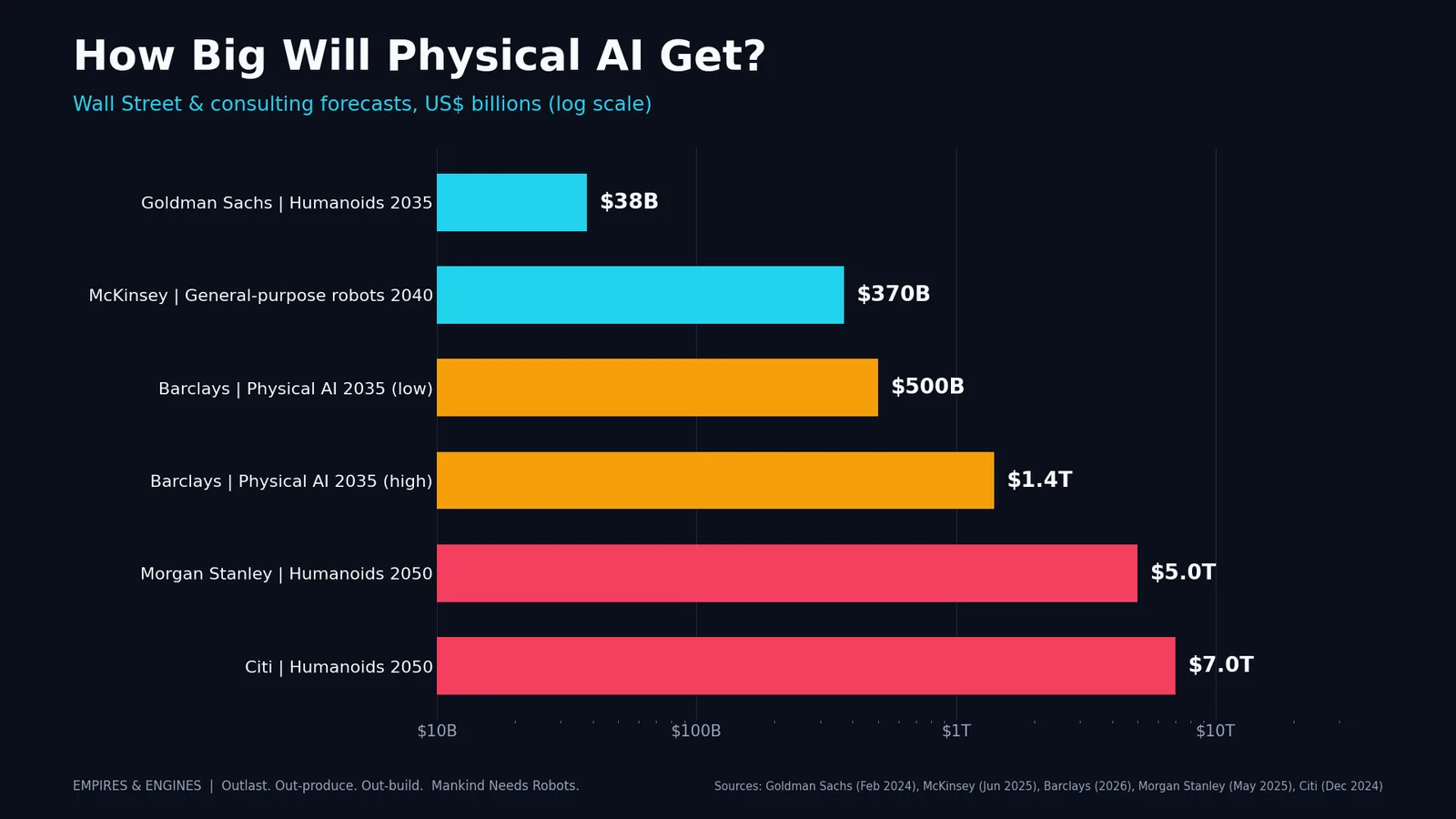
The spread between the lowest and highest estimates is roughly 180-fold. That spread is itself informative: nobody knows the slope of the adoption curve. History suggests treating these estimates as scenarios rather than predictions, a lesson learned from every previous general-purpose technology, whose adoption was slower than enthusiasts expected at first and larger than skeptics expected eventually.
Applying the twelve levers to the current state of competition between the United States and China produces a split verdict.
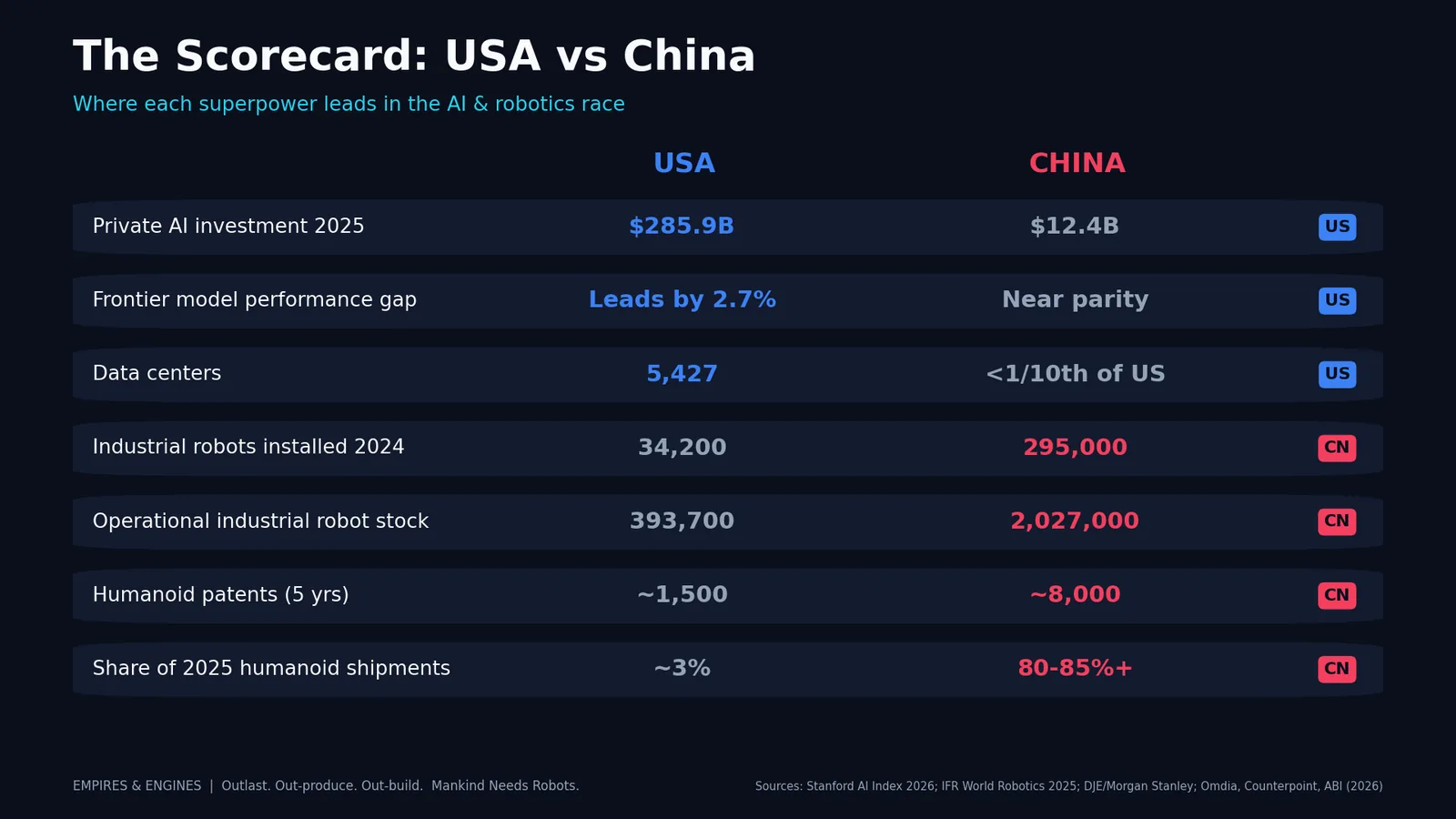
| Lever | United States | China | Assessment |
|---|---|---|---|
| Technology (frontier models) | Leads narrowly; top model ahead by ~2.7% (Stanford, Mar 2026) | Near parity at far lower cost | Contested |
| Technology (robot hardware) | Strong in AI brains and some integrators | Leads in volume, components and cost | China ahead |
| Military | Global alliances, advanced autonomy programs | Rapid modernization, drone manufacturing scale | Contested |
| Trade | Large consumer market; tariffs | Export powerhouse in EVs, batteries, robots | China ahead in manufactured exports |
| Finance | US$285.9B private AI investment in 2025 | State guidance funds; private AI $12.4B tracked | US ahead in private capital |
| Diplomacy | Summit convening power; allied frameworks | Global South outreach; open-model diplomacy | Contested |
| Alliances | Japan, Korea, Taiwan, Netherlands, Europe | Fewer formal allies; partnerships | US ahead |
| Intelligence | Strong signals intelligence | Extensive technology acquisition | Contested |
| Information | Global platforms and media | Open-weight models spreading globally | Contested |
| Law and standards | Export controls; allied standards | National humanoid standards; scale | Contested |
| Talent | Still largest pool of top researchers, but inflows down 89% since 2017 | Large STEM output; returning researchers | Shifting toward China |
| Resources | Energy abundance; grid constraints | Rare-earth processing dominance | China ahead in materials; US in energy |
| Industrial policy | CHIPS Act; reshoring incentives | Five-Year Plans; embodied AI as priority industry | China more sustained |
The International Federation of Robotics reported that 542,000 industrial robots were installed worldwide in 2024, more than double the number a decade earlier, and that the global operational stock reached about 4.66 million units. China accounted for 295,000 installations, 54 percent of the global total, and its operational stock exceeded two million units. The United States installed 34,200 robots in 2024 and had an operational stock of about 393,700, roughly one-fifth of China’s. Preliminary IFR figures presented in June 2026 showed global installations rising about 15 percent in 2025 to roughly 621,000 units, with US installations up 11 percent to 38,000.
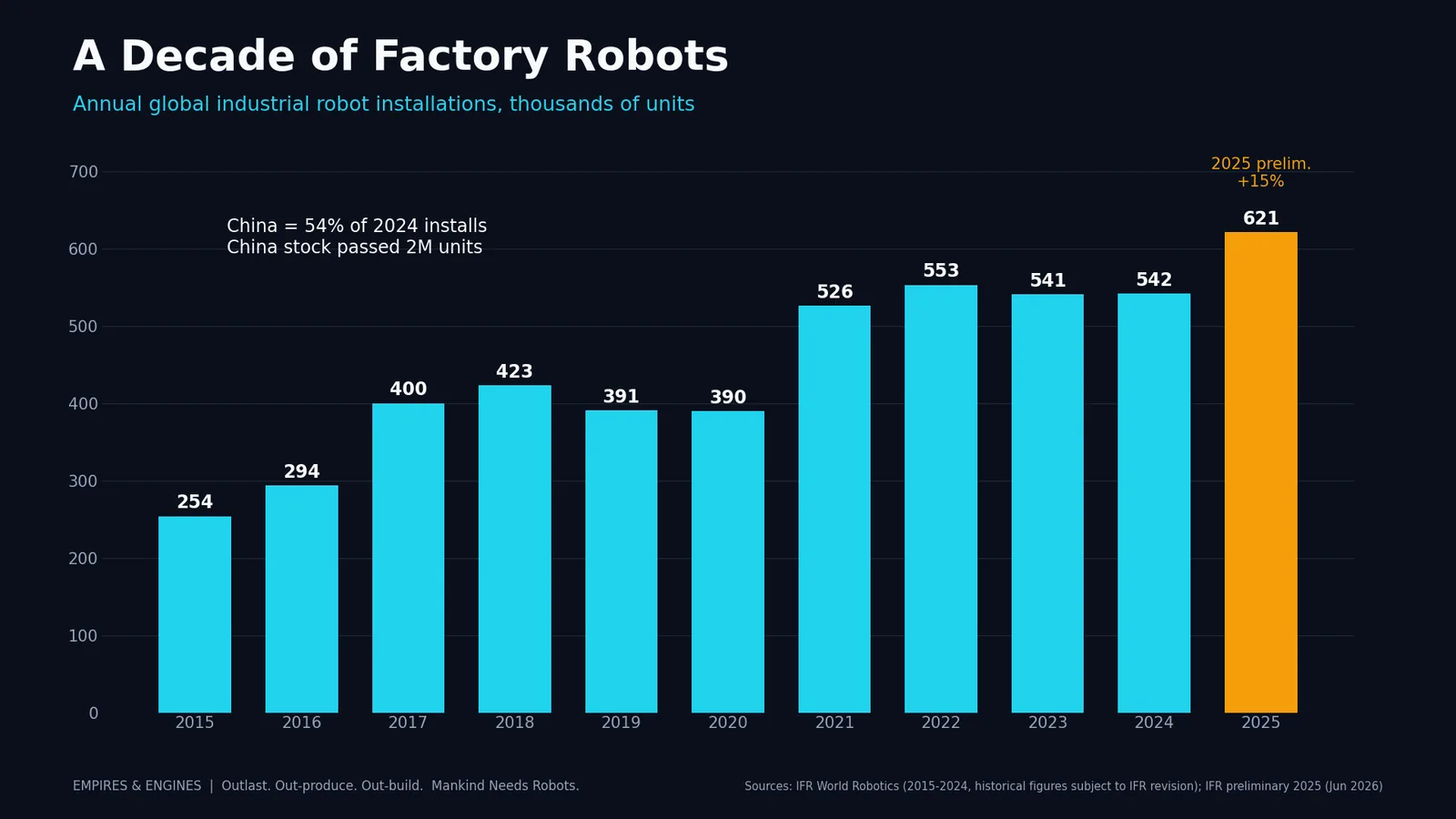
In the language of Law 4, this is a production-scale advantage. Robots are built, maintained and improved by the same ecosystem of engineers, component suppliers and integrators that uses them. A country that installs five times as many robots as its rival is also training five times as many technicians and generating five times as much deployment data.
Independent trackers counted between about 13,000 and 18,600 humanoid robots shipped worldwide in 2025, depending on definitions. Omdia estimated about 13,000 units, with the Shanghai company AgiBot shipping about 5,168 and Hangzhou-based Unitree about 4,200; Unitree itself reported more than 5,500 units. Various trackers put China’s share of 2025 humanoid shipments between roughly 80 and 97 percent. American companies shipped only hundreds of units combined; Tesla, Figure and Agility each shipped on the order of 150 units, according to independent estimates.
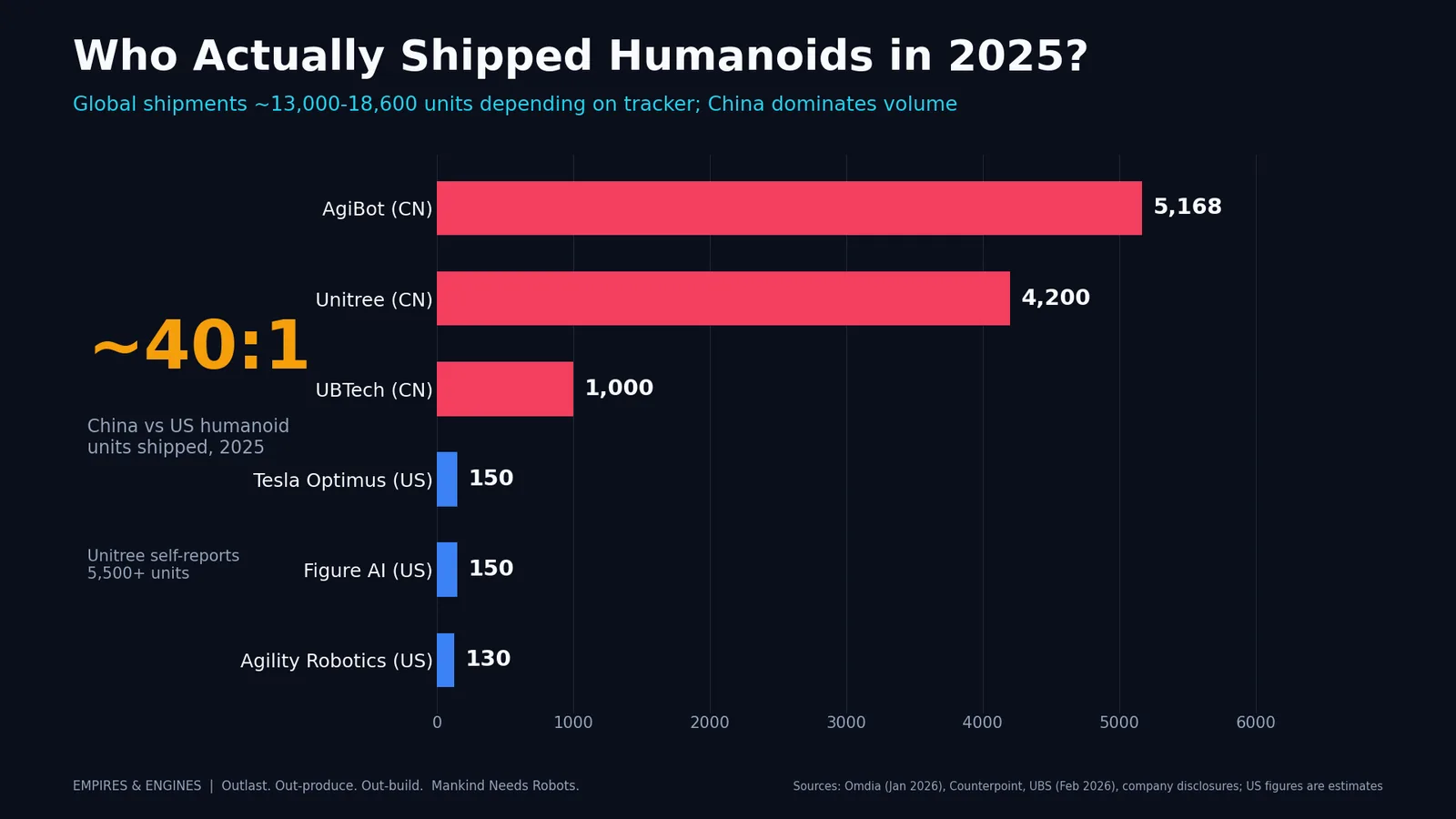
At the same time, American humanoid companies command the highest valuations in the industry. Figure AI raised more than US$1 billion at a US$39 billion post-money valuation in September 2025. Activant Capital noted in June 2026 that this valued a company that had shipped roughly 150 robots above FANUC, the world’s largest industrial robot manufacturer. Apptronik expanded its Series A to US$935 million at a valuation of about US$5.3 billion by February 2026.
This pattern, Chinese volume and American valuation, is a direct reflection of the two national business models. China’s model rewards production and deployment; America’s model rewards expected future dominance. History offers precedents for both outcomes. Sometimes the valuation-rich innovator wins because its technology becomes the standard (American computing in the 1970s and 1980s). Sometimes the production-scale follower wins because it drives costs down faster (Japanese consumer electronics in the 1970s, Chinese solar panels in the 2010s).
Goldman Sachs reported that the estimated manufacturing cost of humanoid robots fell by about 40 percent in a single year, from a range of US$50,000 to US$250,000 per unit to US$30,000 to US$150,000, far faster than the 15 to 20 percent annual decline it had expected. Unitree introduced its R1 humanoid at a list price of about US$5,900 in 2025 and its G1 at about US$16,000. The Norwegian-American company 1X opened pre-orders for its NEO home humanoid at US$20,000. Morgan Stanley’s cost path projects average costs falling from about US$200,000 in 2024 to US$150,000 by 2028 and US$50,000 by 2050.
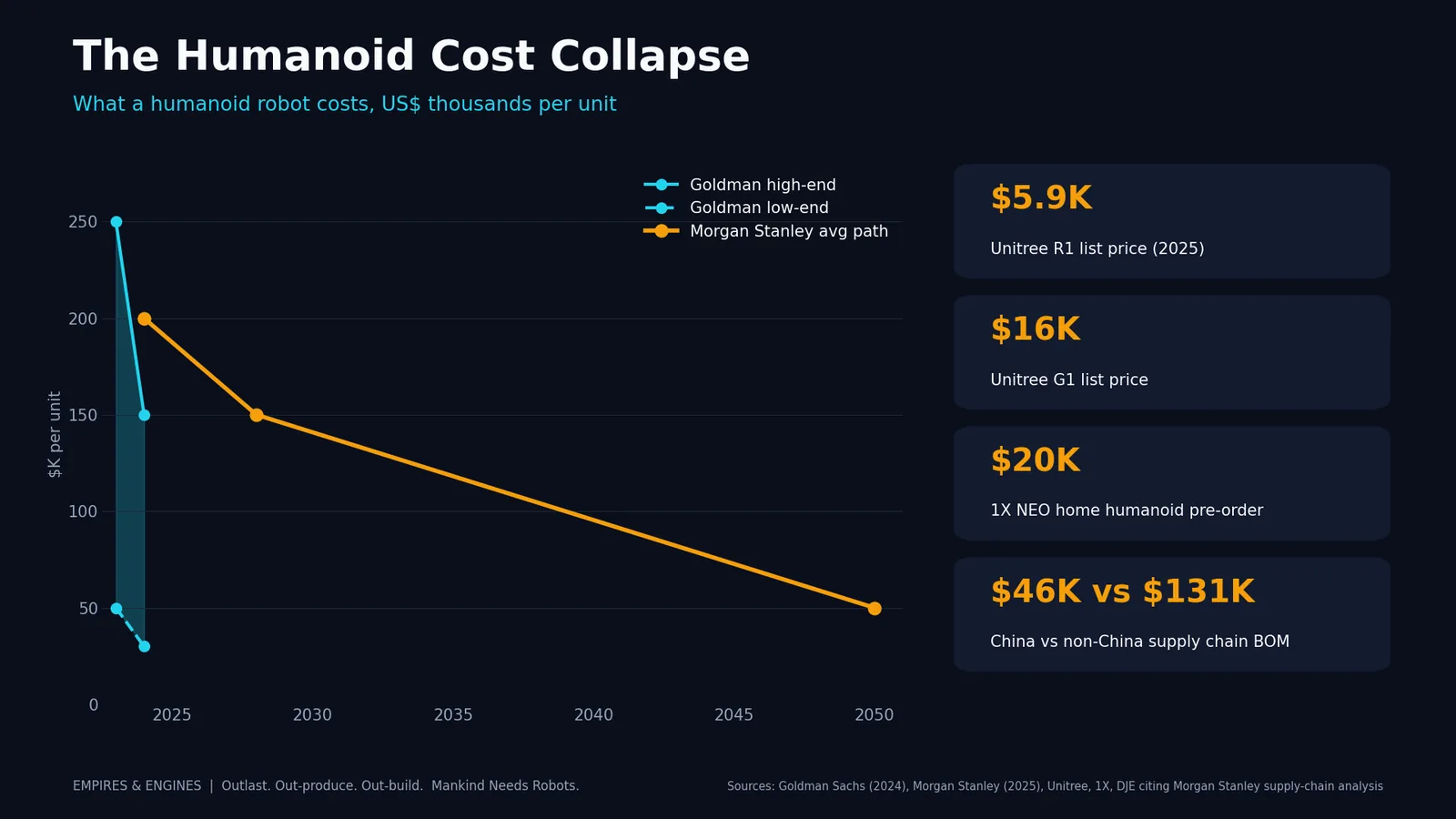
First-principles thinking explains why costs are falling so fast. A humanoid robot is a combination of electric motors, gearboxes, sensors, batteries, compute and software. Most of those components benefit from the same supply chains that serve electric vehicles and smartphones, which China dominates. The humanoid is following the electric-vehicle cost curve, and China built the electric-vehicle supply chain.
Robots need two kinds of computation: large-scale training in data centers and real-time inference inside the machine. The first is being built by the largest private capital expenditure cycle in history. J.P. Morgan estimated in mid-2026 that global AI-related capital expenditures could reach US$5.5 trillion through 2030. BlackRock described infrastructure as the investment of the decade. Blackstone, which acquired the data-center company QTS for about US$10 billion in 2021, reported more than US$150 billion of data-center assets with a further US$160 billion development pipeline, and its founder compared AI’s impact to Edison’s electric light.
The binding constraint is increasingly energy rather than chips. Bain estimated that global AI computing demand could require about 200 gigawatts of capacity by 2030, with the United States accounting for half. BlackRock’s investor surveys showed a majority of clients preferring energy and infrastructure over large technology stocks as a way to invest in AI. In the language of Law 2, electricity is becoming a chokepoint, and robot fleets will compete for the same power as data centers.
Across the major banks, consultancies and investors, a consistent picture emerges, summarized in the Empires & Engines market research. J.P. Morgan and BlackRock see the AI investment cycle as durable but volatile. Morgan Stanley, Citi and Goldman Sachs see a very large but slow-starting humanoid market in which China currently leads. McKinsey, BCG, Bain, Deloitte and EY emphasize that physical AI is moving from pilots toward production but that most deployments remain early, supervised and dependent on better data. PwC’s long-standing estimate that AI could add US$15.7 trillion to global GDP by 2030, with China and North America capturing the largest gains, frames the stakes. KPMG’s CEO surveys show that executives are committing budgets to AI while admitting that most have not yet realized its return on investment.
Thesis Link: Measured by the thesis, China leads on supply chain and production, the US on technology. Neither yet holds all three pillars.
Associative and lateral thinking suggest several historical analogies for the current race, each illuminating a different dimension.
The British textile export ban (1770s to 1840s) and semiconductor controls (2022 onward). Both attempt to preserve a technological lead by restricting the flow of machines and know-how. The British experience suggests that such controls buy years, not decades, and that they accelerate the rival’s domestic capability.
The Venetian Arsenal and the robot gigafactory. Mass production of complex machines with standardized parts is an old idea. Whoever builds the first true humanoid gigafactory at scale will gain a cost and learning-curve advantage, just as the Arsenal did.
The Japanese chip challenge of the 1980s and China’s robotics rise. In both cases, a state-guided challenger used coordinated industrial policy to win volume leadership. But Japan was a US ally dependent on American security guarantees and could be pressured through currency and trade agreements. China is not, and the Plaza Accord playbook is unavailable.
The Sputnik shock and DeepSeek. Both demonstrated that a rival had reached the frontier, and both could trigger a surge of public investment in the leader. Whether DeepSeek produces an American response comparable to ARPA, NASA and the National Defense Education Act remains open.
The Arsenal of Democracy and reshoring. The United States in 1940 to 1945 converted its civilian industrial base to wartime production at unprecedented speed. Tesla’s conversion of its Fremont vehicle line into an Optimus robot line in 2026 is a small-scale echo. Whether the United States can rebuild manufacturing scale is the single largest uncertainty in the race.
Second-order thinking asks what happens after the obvious first effects.
Reshoring and the end of the low-wage model. If humanoid robots become cheap and capable, the labor-cost advantage that allowed developing economies to industrialize will erode. Manufacturing could return to high-wage countries, but it could also concentrate in whichever country builds the cheapest robots. Export-led development, the ladder that Japan, Korea, Taiwan and China climbed, may be pulled up.
Demographics as a demand driver. Aging societies, including Japan, South Korea, China and much of Europe, face shrinking workforces. Morgan Stanley projects China having about 302 million humanoids in use by 2050 versus about 78 million in the United States. Robots may become a form of demographic insurance and even pension policy.
Energy and grid politics. Data centers and robot fleets together could reshape electricity demand. Blackstone’s leadership has pointed to expectations of roughly a 40 percent increase in US electricity demand over a decade. Countries with abundant, cheap, reliable power will gain a structural advantage.
Materials leverage. Every robot actuator requires motors, and most high-performance motors require rare-earth magnets. China’s dominance of rare-earth processing becomes a direct lever over the global robotics industry, as its 2010 restrictions on Japan and later export controls demonstrated.
Military transformation. The war in Ukraine showed that cheap drones can transform battlefields. The same technologies that power factory robots power autonomous weapons. Robotics leadership will translate into military capability, which raises the stakes and the likelihood of further controls.
Distribution of gains. Returns may concentrate among owners of compute, data and robot fleets. States that fail to manage distribution risk political backlash that slows adoption, the modern equivalent of the Luddite riots of the 1810s.
Probabilistic thinking requires assigning rough likelihoods to distinct futures. The scenarios below are judgmental estimates by Empires & Engines, not sourced forecasts.
Scenario A: Bipolar stacks (probability about 45 percent). The world divides into two partially separate technology ecosystems. The United States and its allies lead in frontier models, advanced chips and high-value robots; China leads in volume manufacturing, low-cost robots and components, exporting widely to the Global South. Humanoid adoption follows a path close to Goldman Sachs’ base case through 2035, then accelerates. This resembles the Cold War division, but with far greater trade between the blocs.
Scenario B: China wins the production race (about 25 percent). Chinese manufacturers drive humanoid costs down so fast that Western producers cannot compete outside protected markets, as happened in solar panels and batteries. The United States retains leadership in AI models but becomes dependent on Chinese hardware, or imposes tariffs that raise its own costs. Robotics becomes China’s electric-vehicle moment.
Scenario C: The American platform reasserts itself (about 20 percent). A breakthrough in robot foundation models, US-led and deployed through American platforms, creates an “LLM moment” for robotics. Allied manufacturing (Japan, Korea, Taiwan, Mexico, Europe) scales hardware, the US controls the software and data layer, and the allied coalition, like the post-1945 platform, attracts most of the world.
Scenario D: Stall (about 10 percent). Dexterity, reliability and safety problems prove harder than expected. Humanoids remain niche for a decade, and investment shifts toward specialized robots, autonomous vehicles and software AI. The capital expenditure cycle overshoots and corrects, as the railway and telecom booms did in the nineteenth and twentieth centuries.
The following indicators will reveal which scenario is unfolding. Each connects to a law in Chapter 11.
Thesis Link: Every scenario is decided by who can sustain robot output longest. Drone wars in research, war and transport are already underway.
Five thousand years of history do not predict who will win the race for artificial intelligence and robotics. They do something more useful. They show that nations compete like enterprises, using a stable set of levers, and that the outcome of long contests depends on how well those levers are combined into self-reinforcing loops.
Sumer paired irrigation with writing. Rome paired roads with law and citizenship. Venice paired the Arsenal with convoys and diplomats. The Dutch paired ships with stock markets. Britain paired the navy with the Bank of England and the telegraph. The United States paired mass production with the dollar, universities and alliances. China has paired state finance with manufacturing scale and relentless technology absorption.
The AI and robotics race will be won by whichever system builds the strongest loop among compute, energy, capital, talent, manufacturing scale, data from real-world deployment and the alliances that multiply all of them. The United States currently holds the strongest position in capital, frontier models and alliances. China holds the strongest position in manufacturing, robots, components and deployment volume. Both face serious risks: for the United States, talent outflows, manufacturing weakness and financial overstretch; for China, dependence on foreign chips and tools, demographic decline and the risk of provoking a unified coalition.
History’s clearest lesson is that no lead is permanent, and that the decisive advantage belongs not to the inventor but to the system that deploys invention fastest and most widely. The humanoid robot is the steam engine, the railway and the assembly line of this century. The nations that treat it that way, as a production system to be scaled rather than a demonstration to be admired, will write the next chapter of the history this paper has told.
Thesis Link: The conclusion of history is the thesis itself: the nation that treats robots as a production system to be scaled, not a demonstration to be admired, will outlast its rivals.
Parts I to IV built the framework and applied it to the race in artificial intelligence and robotics. Part V tests the attrition thesis against the live contests of 2025 and 2026: the Russia-Ukraine war, the power race, the shipbuilding gap, Taiwan, the middle powers, the magnet chokepoint, the future of work and the race in orbit. Chapter 24 then states the thesis in full, tests it against its strongest objections and draws the paper’s final conclusion.
The Russia-Ukraine war, which began with Russia’s full-scale invasion in February 2022, is the most important live test of the attrition thesis in the world today. On paper, it is a mismatch. Russia has more than three times Ukraine’s population, a far larger economy, a vast arsenal inherited from the Soviet Union, and nuclear weapons. By the logic of scale alone, Russia should have won quickly.
It did not. More than four years later, Russia holds roughly 19 to 20 percent of Ukraine’s territory, including Crimea and the parts of the Donbas it occupied before 2022, according to a Russia Matters review of DeepState and Institute for the Study of War data. Its net gains since February 2022 amount to about 12 percent of Ukraine, at a cost in military spending estimated at around US$625 billion through March 2026. The Institute for the Study of War assessed in September 2026 that the Russian rate of advance had slowed significantly since 2025 and that Ukraine could contest the tactical initiative in several sectors.
The war shows both halves of the thesis at once. Russia is running a classic attrition strategy based on mass, production and endurance. Ukraine is showing how technology and efficient production can let a smaller nation impose disproportionate costs on a larger one. The outcome is not yet decided, and this chapter treats it with that caution.
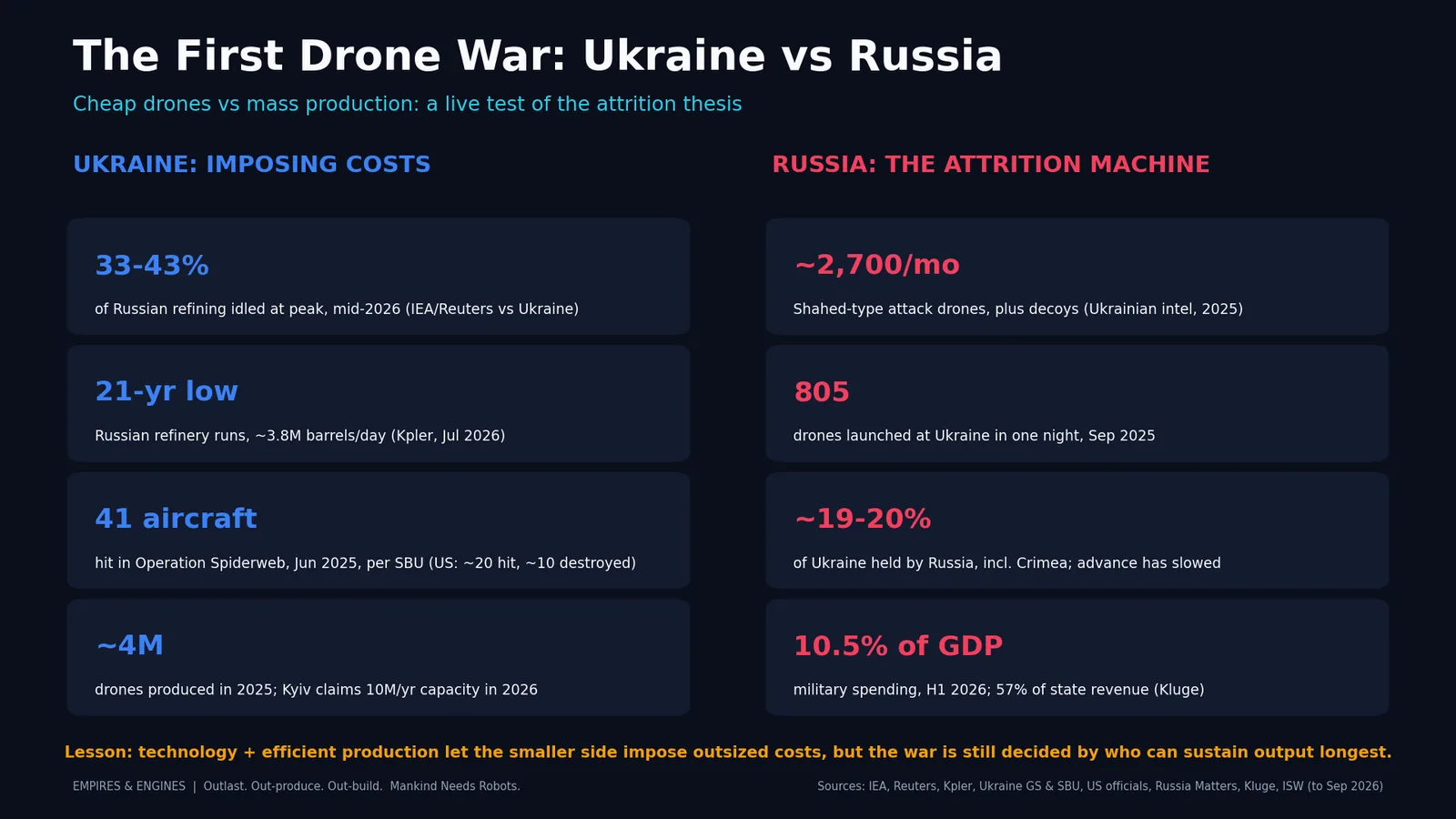
Ukraine could not match Russia tank for tank or shell for shell. Instead, it used technology and cheap, fast production to strike high-value targets, a strategy the Byzantines, the Portuguese and every successful small power in this paper would recognize.
The Black Sea. In April 2022, Ukrainian Neptune missiles sank the Moskva, flagship of Russia’s Black Sea Fleet. Ukraine then developed uncrewed surface vessels, sea drones, that repeatedly struck Russian warships. Al Jazeera, summarizing expert assessments in 2025, reported that these attacks forced the Russian navy to shift from Crimea to the shelter of Novorossiysk. Ukrainian sea drones were later adapted to carry missiles and, according to Ukrainian claims reported in May 2025, shot down Russian Su-30 fighter jets, a first in military history. A country with almost no conventional navy neutralized much of a great power’s fleet.
Operation Spiderweb. On 1 June 2025, Ukraine’s Security Service (SBU) launched first-person-view drones from trucks that had been smuggled deep into Russia, striking strategic bomber bases including Olenya in the Arctic, almost 2,000 kilometers from Ukraine, and Belaya in Siberia. The SBU said the operation, planned over 18 months, destroyed or damaged 41 aircraft worth more than US$7 billion. Independent and US assessments were lower (a US estimate put the total at about 20 aircraft hit, around 10 of them destroyed), but even the conservative figures represent a significant share of Russia’s long-range bomber fleet, destroyed by drones costing a tiny fraction of their targets.
The refinery campaign. From August 2025, Ukraine systematically struck Russian oil refineries, fuel depots and export terminals, reaching targets more than 1,100 kilometers inside Russia. By mid-2026, the commodities data firm Kpler reported that Russian refinery runs had fallen to about 3.8 million barrels per day, the lowest level in 21 years. Estimates of the share of Russian refining capacity offline ranged from 33 to 40 percent (the International Energy Agency and Reuters-cited industry sources) to 42.7 percent (Ukraine’s General Staff) and about half (a Ukrainian energy analyst). Fuel shortages spread to dozens of Russian regions. Because oil and gas taxes account for roughly a quarter of Russia’s federal revenue, according to Reuters, the refinery campaign is a direct attack on Russia’s ability to pay for the war. Ukrainian commentators call it “long-range sanctions.”
Mass drone production. Ukraine turned its defense sector into one of the world’s largest drone manufacturers, built largely from commercial components and small workshops. Industry reports estimate that Ukraine produced around four million unmanned systems in 2025, and President Zelensky has claimed a capacity of ten million drones a year in 2026, with a goal of twenty million. These are government claims and should be treated with caution, but independent observers, including Anduril founder Palmer Luckey, have described Ukrainian production of interceptor drones in the tens of thousands per month. Interceptor drones, which ram Russian attack drones in flight, offer a far cheaper defense than conventional air-defense missiles.
Lever Lesson: Ukraine is applying Law 11, cost imposition, with modern tools. Each of its signature operations destroys assets worth hundreds or thousands of times the cost of the weapons used. It is the Byzantine strategy of doing more with less, backed by an industrial base that can produce the cheap weapons at scale.
Russia’s response is a textbook attrition strategy, and it has real strengths.
Mass production of long-range drones. At the Alabuga Special Economic Zone in Tatarstan, Russia built what analysts describe as the world’s largest factory for Shahed-type attack drones, originally an Iranian design produced in Russia as the Geran-2. Ukrainian military intelligence said in 2025 that Russia could produce up to about 2,700 of these attack drones per month, plus a similar or larger number of decoys. Satellite imagery reported by Ukrainian media in September 2026 showed the plant continuing to expand, including underground workshops, a response to Ukrainian strikes on the site.
Saturation attacks. Russia has used this output to launch massive combined drone and missile strikes on Ukrainian cities and energy infrastructure. In one night in September 2025, Russia launched 805 drones and 13 missiles at Ukraine; the strike damaged the Cabinet of Ministers building in Kyiv. The strategy is designed to exhaust Ukraine’s air defenses, which must intercept nearly everything, while Russia needs only a fraction to get through.
Grinding ground offensives. On the front line, Russia relies on artillery, glide bombs and repeated infantry assaults to push forward slowly, accepting very heavy losses. A former senior Western official cited by Russia Matters estimated in February 2026 that Russia had suffered about one million military casualties (killed and wounded) compared with 250,000 to 300,000 for Ukraine. Casualty figures in this war are highly uncertain and contested, but every credible estimate shows Russia paying a far higher human price.
The cost of endurance. Russia’s economy has been placed on a war footing. German economist Janis Kluge calculated that in the first half of 2026, Russia spent 10.5 percent of GDP on the military, consuming 57 percent of state budget revenue. The Russian Ministry of Finance reported a federal budget deficit of 5.8 trillion rubles for January to August 2026, about 35 percent above the deficit it had forecast for the entire year. Social spending has been cut and taxes raised.
Lever Lesson: Russia is betting on Law 4, scale wins wars of production, and on the hope that its larger population and economy can outlast Ukraine and Ukraine’s Western supporters. It is also paying the price described in Law 10, overextension: the war consumes resources that would otherwise build Russia’s future economy.
| Pillar | Ukraine | Russia |
|---|---|---|
| Supply chain | Depends on Western weapons, finance and components, but has built a dispersed domestic drone industry and joint ventures with the EU, UK and US | Domestic defense industry plus imports and components from China, Iran and North Korea; sanctions raise costs |
| Efficient production | Very high: cheap drones, fast iteration, workshop manufacturing, cost-exchange advantage | High volume: Shahed production at scale, artillery and glide bombs, but at enormous human and financial cost |
| Technology | Innovative in sea drones, deep strikes, interceptors and autonomy | Improving fast; copies and scales successful designs, including fiber-optic drones |
| Endurance | Smaller population and economy; dependent on allied support | Larger reserves of people and money, but deficits growing and oil revenue under attack |
The scorecard explains why the war has become a stalemate of attrition. Ukraine has the edge in technology and production efficiency; Russia has the edge in raw scale. Each side is attacking the other’s ability to endure: Russia by striking Ukraine’s power grid and cities, Ukraine by striking Russia’s oil revenue and military production.
In his address to the UN General Assembly on 23 September 2026, the second day of the high-level debate, President Zelensky described Ukraine’s long-range campaign in terms that restate the attrition thesis almost word for word:
“For the first time in Russia’s history, we now hear that its pride, its oil industry, is running on fumes. But oil itself is not Ukraine’s target, not our target. Not gasoline or diesel, not factories or ports as such. Our target is Russia’s ability to finance this war, to drag it out, to make it more brutal and more destructive. Russia’s finances and Russia’s production are what must be stopped if Putin is to be stopped.”
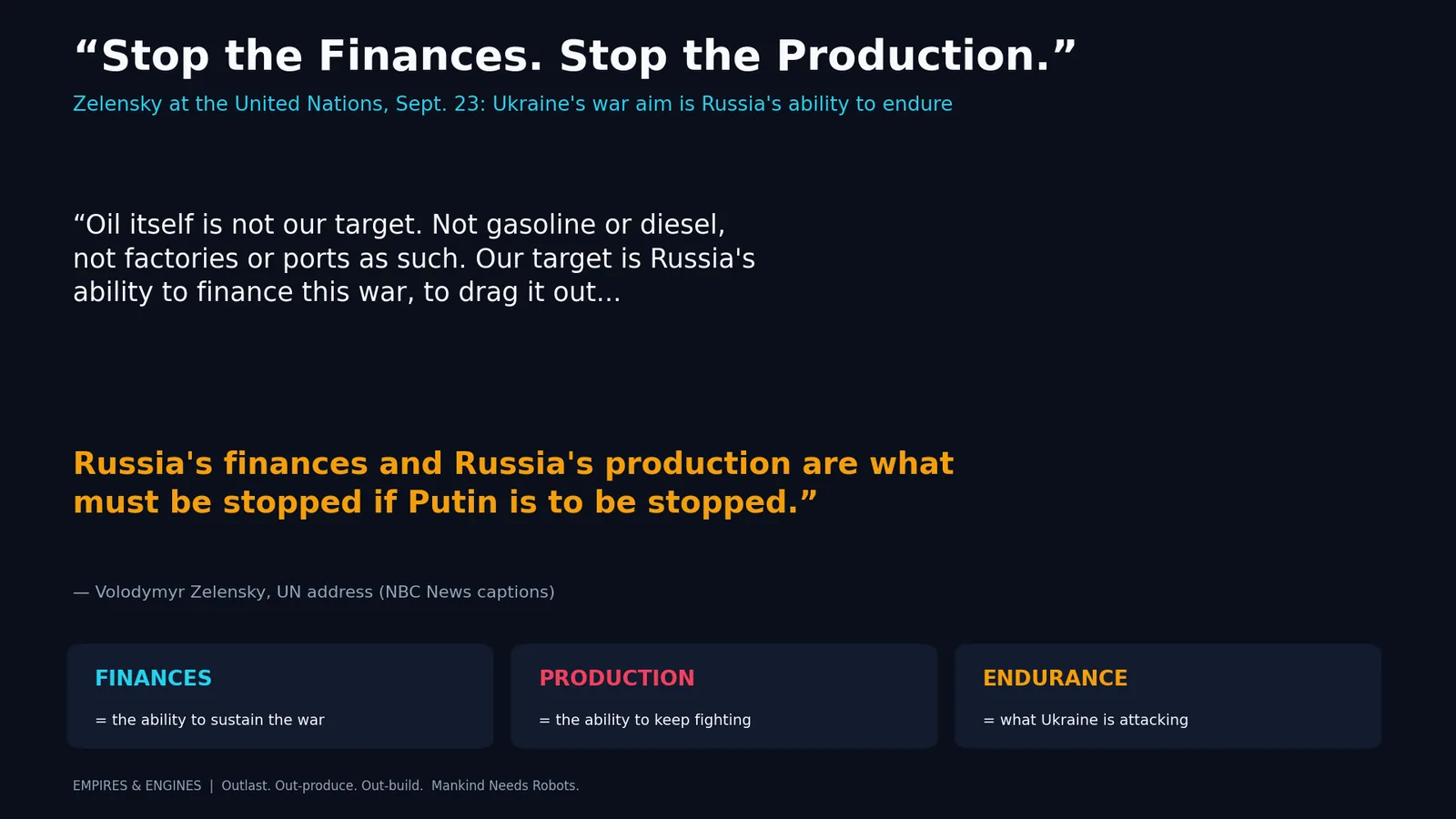
Three points stand out. First, Zelensky frames the war explicitly as a contest of endurance: the aim is to deny Russia the ability “to drag it out.” Second, he names the two variables this paper treats as decisive in every era, finances and production, echoing Law 3 (finance multiplies force) and Law 4 (scale wins wars of production). Third, he defines targets by their function rather than their type. Refineries matter not as oil infrastructure but as sources of the revenue and fuel that sustain the war machine. It is the same logic behind the British blockade of 1914 and the Allied bombing of German oil and industry in 1944: strike the base that lets an enemy keep fighting.
In the same address, Zelensky called Putin “patient zero” of war and instability, and CNN reported that Russia struck his party’s headquarters while he was speaking. He also argued that Putin is always looking for help to “kill more people for every kilometer of land” rather than stopping and running his own country, and asked whether anyone can imagine him without war. That is a political judgment from one side of the conflict, and it should be presented as such. But the strategic logic he describes is general: when a larger power is willing to pay enormous human costs for territory, the smaller side’s best path is to make the war financially and industrially unsustainable.
Lever Lesson: A wartime head of state has publicly defined victory as destroying the enemy’s capacity to finance and produce. That is the attrition thesis applied as national strategy.
As of this writing in September 2026, diplomacy is active. The Institute for the Study of War reported that on 6 September 2026, President Zelensky met US envoys Steve Witkoff and Jared Kushner in Kyiv and agreed on fundamental principles for ending the war, including security and economic guarantees for post-war Ukraine. At the same time, fighting continued: Russia Matters reported a net Russian gain of about 58 square miles in the four weeks to mid-September 2026, while Ukraine retook ground in some sectors.
Metacognitive discipline requires stating plainly what is not known. Neither side has won, and describing the war as a Ukrainian victory or a Russian victory would be premature. What can be said is that Ukraine has imposed costs on Russia out of all proportion to its size, and that Russia’s attrition strategy has produced slow, extremely expensive gains.
Drones are robots. The motors, batteries, sensors, chips and autonomy software that power military drones are the same components that power humanoids, delivery robots and autonomous vehicles. The war has created the world’s most demanding testbed for cheap autonomous machines, and the skills and factories it built will outlast it.
Cost-exchange ratios decide endurance. A US$500 drone that destroys a multi-million-dollar asset changes the economics of war. The same logic applies to industry: whichever nation produces capable robots at the lowest cost can deploy them longest.
Production scale still matters. Ukraine’s innovations have not ended the war, because Russia keeps producing. Technology multiplies force; it does not replace the need to out-produce.
Hitting the rival’s revenue is the modern blockade. In Zelensky’s own words, Ukraine’s target is “Russia’s finances and Russia’s production.” The refinery campaign is the drone-age version of the British blockade of 1914. In a future technology race, the equivalent may be cyberattacks on factories, export controls on components, or strikes on power grids that feed data centers.
Allies are the supply chain. Ukraine’s endurance depends on European and American finance, weapons and components; Russia’s depends on China, Iran and North Korea. In the robot race, alliance supply chains will be decisive in the same way.
Lever Lesson: The first drone war confirms the core thesis in its refined form. Technology and efficient production allow the smaller side to impose outsized costs, but victory ultimately goes to whoever can sustain output, finance and morale the longest. The nations studying this war most closely are building drone and robot industries accordingly. Drone wars in every capacity are no longer a forecast. They are the present.
Thesis Link: Zelensky himself told the UN General Assembly on 23 September 2026 that Russia’s finances and production “are what must be stopped if Putin is to be stopped.” Russia and Ukraine show both halves of the thesis at once: technology and efficient production let the smaller side impose outsized costs, while the war itself is decided by who can sustain output the longest.
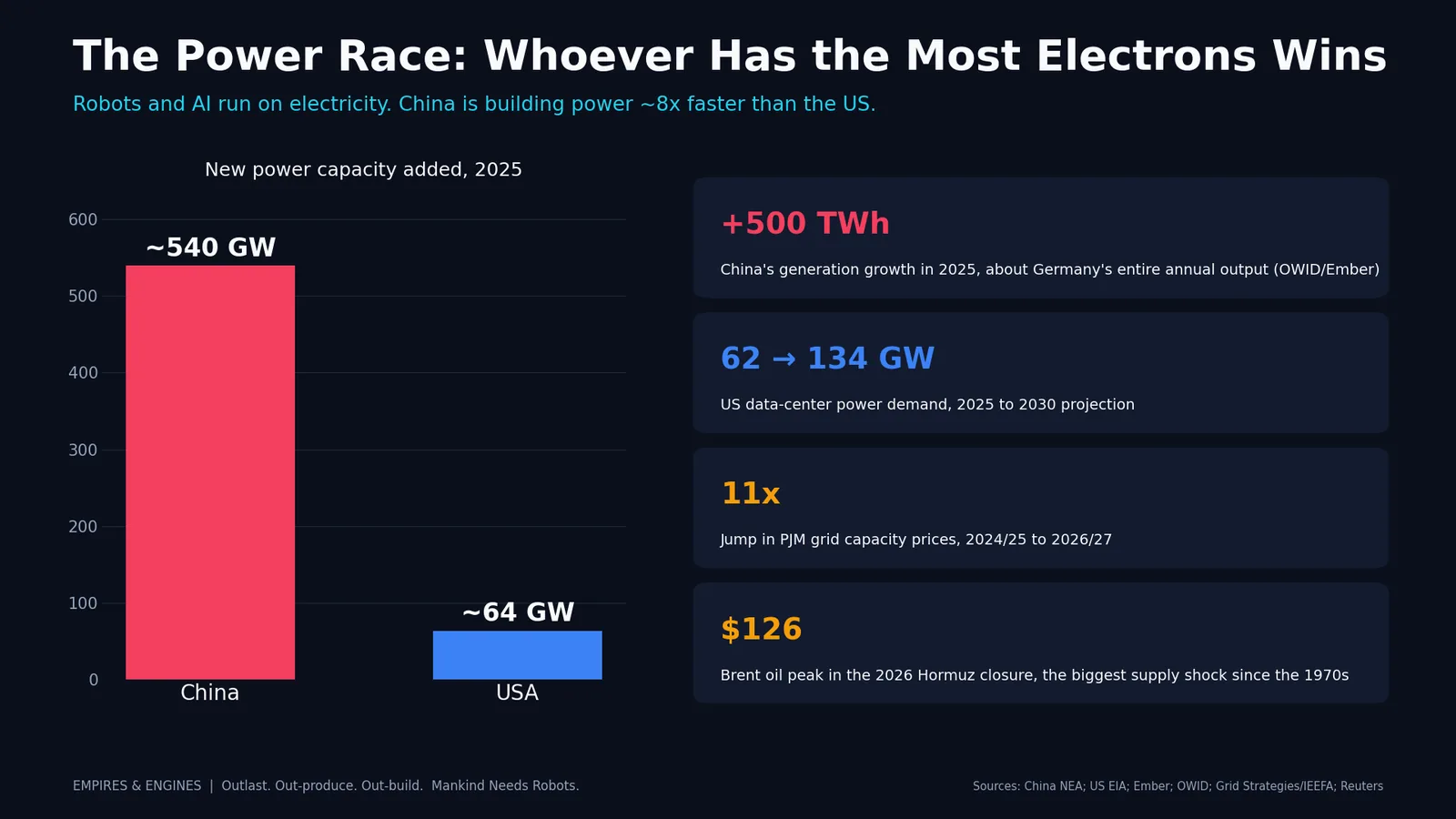
Every lever in this paper ultimately runs on energy. Sumer’s surplus came from the sun and the Euphrates. Britain’s industrial lead rested on cheap coal. America’s wartime production rested on abundant oil and hydroelectric power. The robot economy will run on electricity: to train AI models in data centers, to charge robot batteries, and to power the factories that build robots. First-principles thinking reduces the whole race to a simple question: who can produce the most electricity, most cheaply, for the longest time?
On this measure, China is running away from the field. China’s installed power capacity rose from about 3.35 terawatts at the end of 2024 to about 3.89 terawatts a year later, net additions of roughly 540 gigawatts in a single year, according to National Energy Administration data analyzed by CarbonCredits. That analysis estimated China’s total net growth at more than eight times the US figure. Over the four years to 2025, China added roughly 1,500 gigawatts, more than the entire current US electricity system, according to data cited by Bloomberg.
The growth is not only capacity on paper. Ember’s Global Electricity Review 2026 reported that China’s solar generation alone rose by 336 terawatt-hours in 2025, more than the entire world added in 2023 and four times the next-largest increase, in the United States. China accounted for 58 percent of global solar installations and 72 percent of global wind installations that year. Chinese leaders have explicitly linked stable, affordable power to energy-intensive sectors including artificial intelligence and robotics manufacturing.
Critical thinking requires noting the weaknesses. Some new Chinese coal capacity sits underused, and the grid struggles to absorb intermittent renewable output in some regions. Overbuilding is costly. But in an attrition contest, spare capacity is a strategic reserve, not only an inefficiency.
The United States faces the opposite problem: demand is surging faster than it can build. Utility forecasts of five-year peak demand growth jumped from 38 gigawatts in 2023 to 128 gigawatts in 2024, according to Grid Strategies, driven mainly by data centers. One projection has US data-center power demand rising from about 62 gigawatts in 2025 to about 134 gigawatts by 2030. In the PJM grid serving much of the eastern United States, capacity prices rose roughly elevenfold between the 2024/25 and 2026/27 delivery years, and data centers drove about 40 percent of a US$16.4 billion capacity auction in December 2025. Around 2,600 gigawatts of proposed generation and storage sat in US interconnection queues in early 2026, with waits of five years or more.
Bain’s estimate that global AI compute could require about 200 gigawatts by 2030, half of it in the United States, and Blackstone’s expectation of a sharp rise in US electricity demand both point to the same conclusion: in America, power, not chips, is becoming the binding constraint on AI and, eventually, on robot fleets.
In late February 2026, after a joint US-Israeli attack on Iran, Iran moved to close the Strait of Hormuz, through which roughly a fifth of global oil supply normally passes. The effective closure became the largest disruption in the history of the world oil market. Brent crude surpassed US$100 per barrel in March for the first time in four years and peaked at about US$126, and the International Maritime Organization reported some 2,000 ships and 20,000 mariners stranded in the Persian Gulf.
The crisis illustrates three laws at once. Law 2: the chokepoint controller can shock the whole system. Law 11: cost imposition works even for a weaker state. And a Janusian twist: the same crisis strengthened the United States as an energy exporter, with US crude exports surging to a record above six million barrels per day as buyers sought alternatives. Meanwhile China and India, the destination for about half of the oil passing through Hormuz according to Fitch, were exposed. China’s massive electrification and domestic solar build-out now look like a strategic hedge against exactly this kind of shock.
Britain’s coal gave it the energy to industrialize first. The United States in 1941 produced most of the world’s oil, and the Allied oil advantage shaped the war. Germany and Japan went to war in part to secure energy they lacked. The lesson is consistent: energy abundance is endurance.
Lever Lesson: China is building the power base for a robot economy at a scale no country has ever matched. The United States has abundant energy resources but a grid that cannot connect new supply fast enough. Energy is where America’s attrition advantage is weakest relative to its potential.
Thesis Link: Electricity is the supply chain beneath every other supply chain. The nation that can generate the most power for the longest can run the most robots.
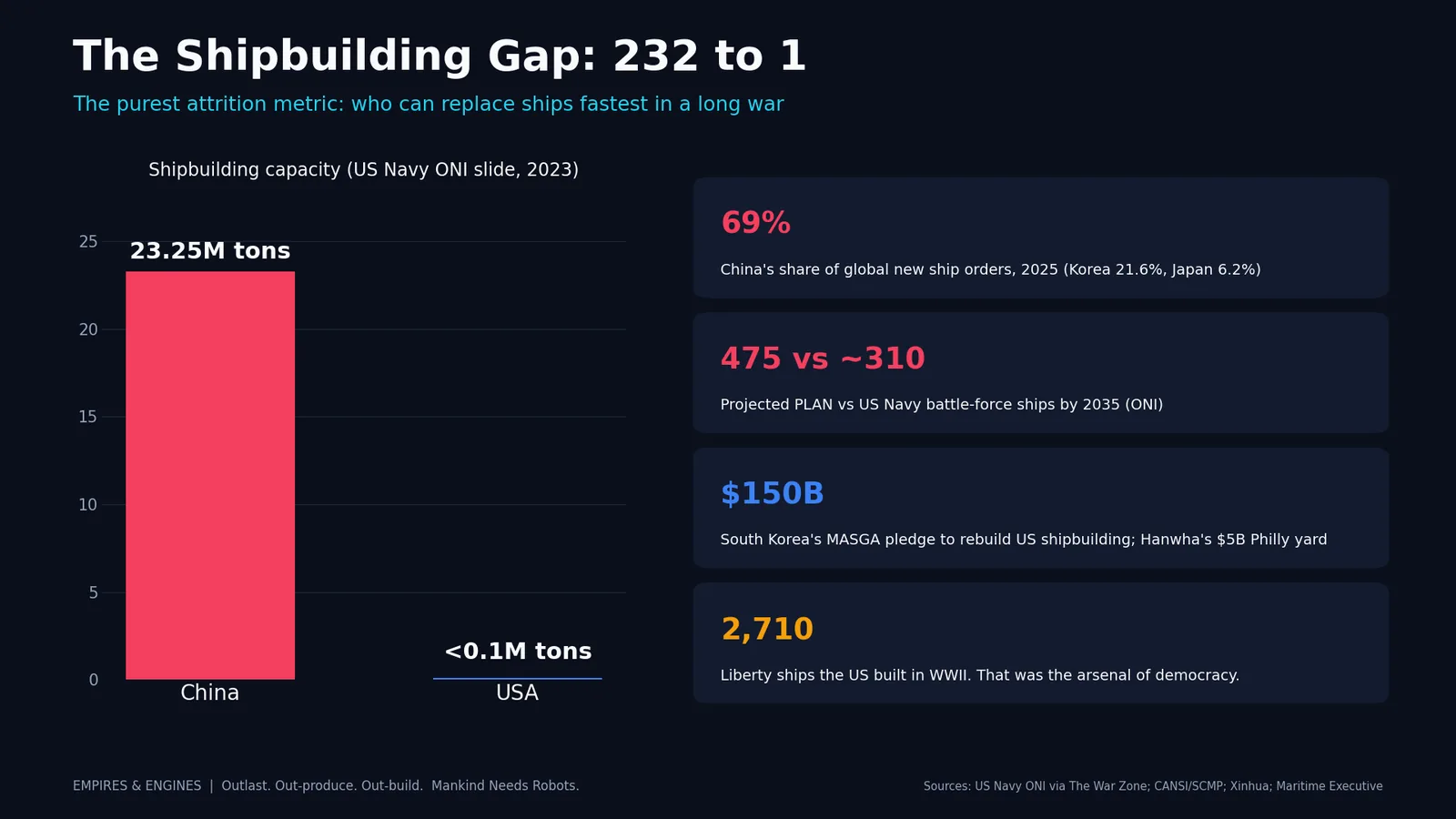
If one statistic captures the attrition thesis, it is shipbuilding capacity. In a long war in the Pacific, ships will be sunk. The side that can replace them fastest will win, exactly as Rome won the First Punic War by rebuilding fleet after fleet.
In 2023, a US Office of Naval Intelligence briefing slide, later confirmed as authentic by the Navy, estimated China’s shipbuilding capacity at about 23.25 million tons compared with less than 100,000 tons for the United States, a ratio of roughly 232 to 1. The same slide projected China’s naval battle force growing to about 475 ships by 2035 against 305 to 317 for the US Navy. A Navy spokesperson cautioned that the slide was not an in-depth analysis, but no serious observer disputes the direction or scale of the gap.
China’s naval strength rests on the world’s largest commercial shipbuilding industry. According to China’s industry ministry, Chinese yards produced 53.69 million deadweight tons in 2025, 56.1 percent of the global total, and won new orders of 107.82 million tons, a 69 percent share. Their orderbook stood at about two-thirds of the global total. South Korea’s share of new orders rose to 21.6 percent; Japan’s slipped to 6.2 percent. Senators noted in 2026 that China built less than 5 percent of commercial ships in 2000 and more than half by 2025.
This is industrial policy compounding over a quarter century, supported by subsidies, cheap finance and state demand, and it gives China what the United States had in 1941: a vast civilian industrial base that can be converted to military production.
During the Second World War, American shipyards built 2,710 Liberty ships, along with thousands of other vessels, at a pace that overwhelmed German U-boat attrition. That capacity then declined for decades. Today the arsenal of democracy, at sea, is largely gone.
The United States is now trying to rebuild using its alliances (Law 5). Under an initiative branded “MASGA,” or “Make America Shipbuilding Great Again,” South Korea pledged up to US$150 billion to help revive American shipbuilding. Hanwha Ocean, which bought Philly Shipyard in 2024 for US$100 million, announced a further US$5 billion investment, and HD Hyundai Heavy Industries, the world’s largest shipbuilder, explored acquiring US yards.
Washington also used trade levers. After a Section 301 investigation concluded that China had unfairly targeted maritime dominance, the US imposed port fees on China-linked vessels from October 2025. China retaliated with its own port fees and sanctions on five US subsidiaries of Hanwha. The fees were subsequently paused amid US-China trade negotiations, and in June 2026 US senators urged their reinstatement.
The obstacles are severe. South Korea’s defense procurement minister told lawmakers he did not see how all the materials and supplies for Philly Shipyard could be made within the United States. The supply chain, not just the shipyard, has to be rebuilt.
A shortage of skilled welders, fitters and shipwrights is one of the deepest constraints on American shipbuilding. This is the attrition thesis in its clearest form: where human labor is scarce and expensive, the race to efficiency requires automation. Robotic welding, automated block assembly, digital-twin design and, eventually, humanoid and mobile robots working in shipyards are the most plausible path to closing even part of the gap. Korea’s and Japan’s yards, among the most automated in the world, are the model.
Lever Lesson: The 232-to-1 gap is the attrition thesis written in steel. The United States cannot close it with money alone; it needs allied capacity, rebuilt supply chains and robots that multiply a limited workforce.
Thesis Link: Shipbuilding is the attrition thesis in steel. The side that replaces losses fastest wins the long war.
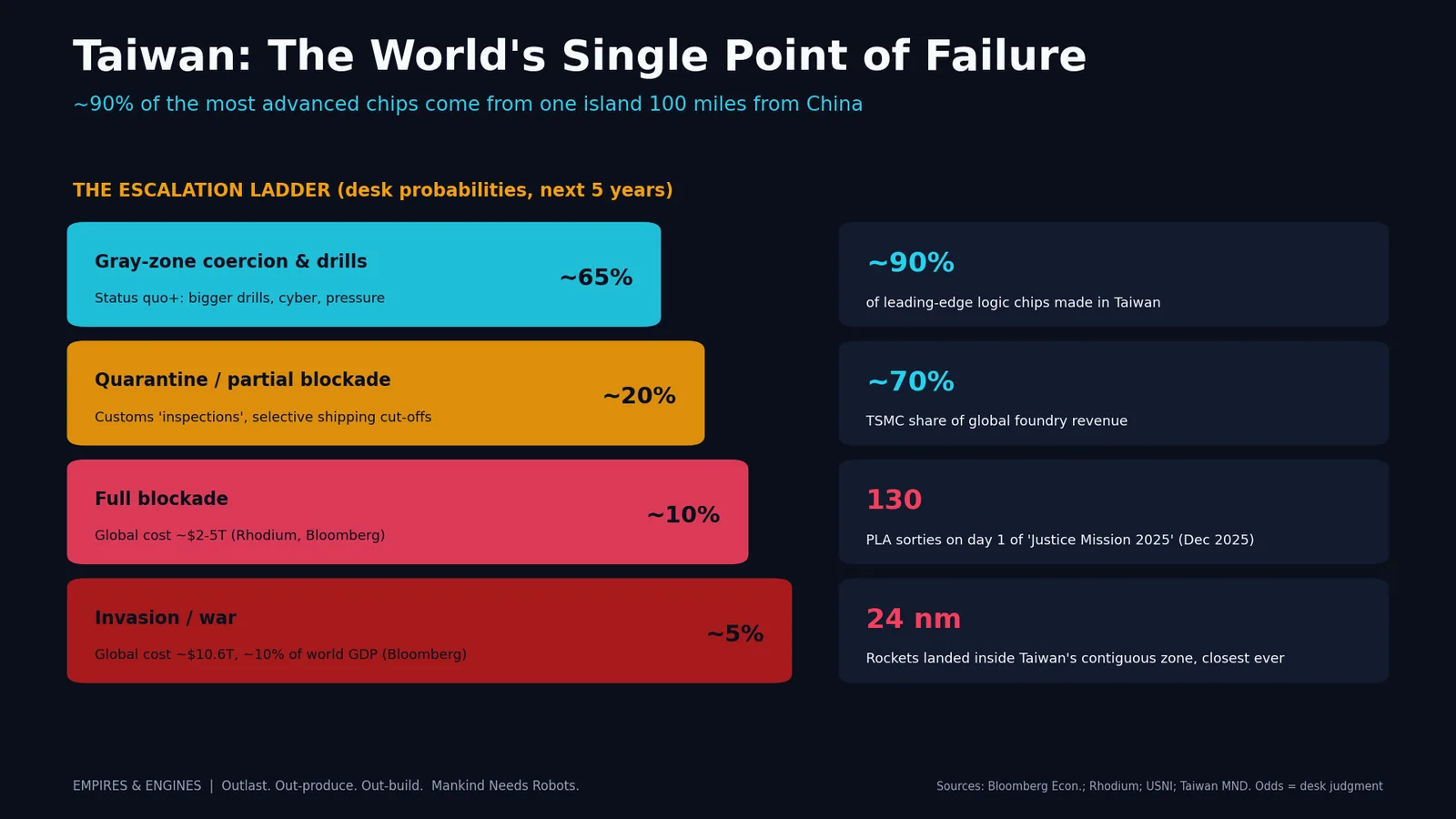
Every forecast in this paper, from Morgan Stanley’s billion humanoids to J.P. Morgan’s US$5.5 trillion of AI capital expenditure, assumes that Taiwan keeps shipping chips. Taiwan Semiconductor Manufacturing Company controls roughly 70 percent of global foundry revenue, and Taiwan produces about 90 percent of the world’s most advanced logic chips. Rest of World reported in 2026 that TSMC produces roughly 99 percent of the chips used to train frontier AI models. The chips that serve as robot brains are overwhelmingly made on one island about 100 miles from mainland China.
This is Law 2 at its most extreme. Portugal controlled Malacca; Britain controlled the cables; Taiwan controls the silicon. The concentration is sometimes called a “silicon shield,” on the theory that the world’s dependence on Taiwan deters attack. It could equally be described as a single point of failure for the entire technology race.
China regards Taiwan as part of its territory and has not ruled out the use of force. Pressure has intensified. In April 2025, the PLA’s “Strait Thunder-2025A” exercise included the Shandong carrier strike group. On 29 and 30 December 2025, after the United States announced an US$11.1 billion arms package for Taiwan, the largest ever, the PLA staged “Justice Mission 2025.” The drills rehearsed blockading key ports, involved about 130 air sorties on the first day, with 90 crossing the median line, and put rockets into Taiwan’s contiguous zone, within 24 nautical miles of its coast, for the first time. Analysts described the exercise as a rehearsal for a full blockade. Some analysts assess that Xi Jinping has instructed the military to be capable of taking Taiwan by 2027, though capability is not the same as intent.
Bloomberg Economics estimated that a war over Taiwan would cost the global economy about US$10 trillion, roughly 10 percent of world GDP, refined in February 2026 to about US$10.6 trillion, or 9.6 percent. That would exceed the economic cost of the COVID-19 pandemic. A blockade would be less catastrophic but still severe: estimates range from about US$2 trillion (Rhodium Group) to about US$5 trillion (Bloomberg Economics). In a war scenario, Bloomberg’s modeling showed China’s own economy contracting sharply, a reminder that Law 11 cuts both ways.
Probabilistic thinking helps structure the risk. The following ladder reflects Empires & Engines’ judgment for the next five years; the probabilities are not sourced forecasts.
| Rung | Description | E&E probability |
|---|---|---|
| Gray-zone coercion | Larger drills, cyber activity, economic and political pressure, no blockade | About 65% |
| Quarantine or partial blockade | Chinese “customs inspections” or selective cut-offs that let Beijing decide who receives chips | About 20% |
| Full blockade | Sustained interruption of Taiwan’s trade | About 10% |
| Invasion or war | Direct military conflict | About 5% |
The most dangerous scenario may be the middle rung. A quarantine would not require firing a shot, yet it would give Beijing a hand on the valve of the world’s AI supply. As Rest of World observed, in that world TSMC keeps operating, but Beijing decides who gets the chips.
The response follows the patterns of history. The US CHIPS and Science Act subsidizes domestic fabs, and TSMC has built production in Arizona, alongside new plants in Japan and Germany. Allies are diversifying. But leading-edge capacity outside Taiwan remains a small fraction of the total, and fabs depend on Dutch lithography machines, Japanese chemicals, American design software and tens of thousands of specialized engineers. Rebuilding that ecosystem elsewhere takes years.
Lever Lesson: In the attrition thesis, the best supply chain wins, but a supply chain concentrated in one place can be broken in one move. Endurance in the robot age requires more fabs in more places, the chip-era equivalent of Britain’s global network of coaling stations.
Energy, ships and chips form one system. Chips are the robot’s brain, energy is its food, and ships carry the materials and finished goods that connect every supply chain. China leads decisively in two of the three (energy build-out and shipbuilding), while the most advanced chips remain in allied hands, concentrated on an island within China’s reach. By the attrition thesis, the balance of endurance currently favors whichever side can protect its weakest link longest.
Thesis Link: Taiwan shows that the best supply chain can also be the most fragile. Endurance means redundancy.
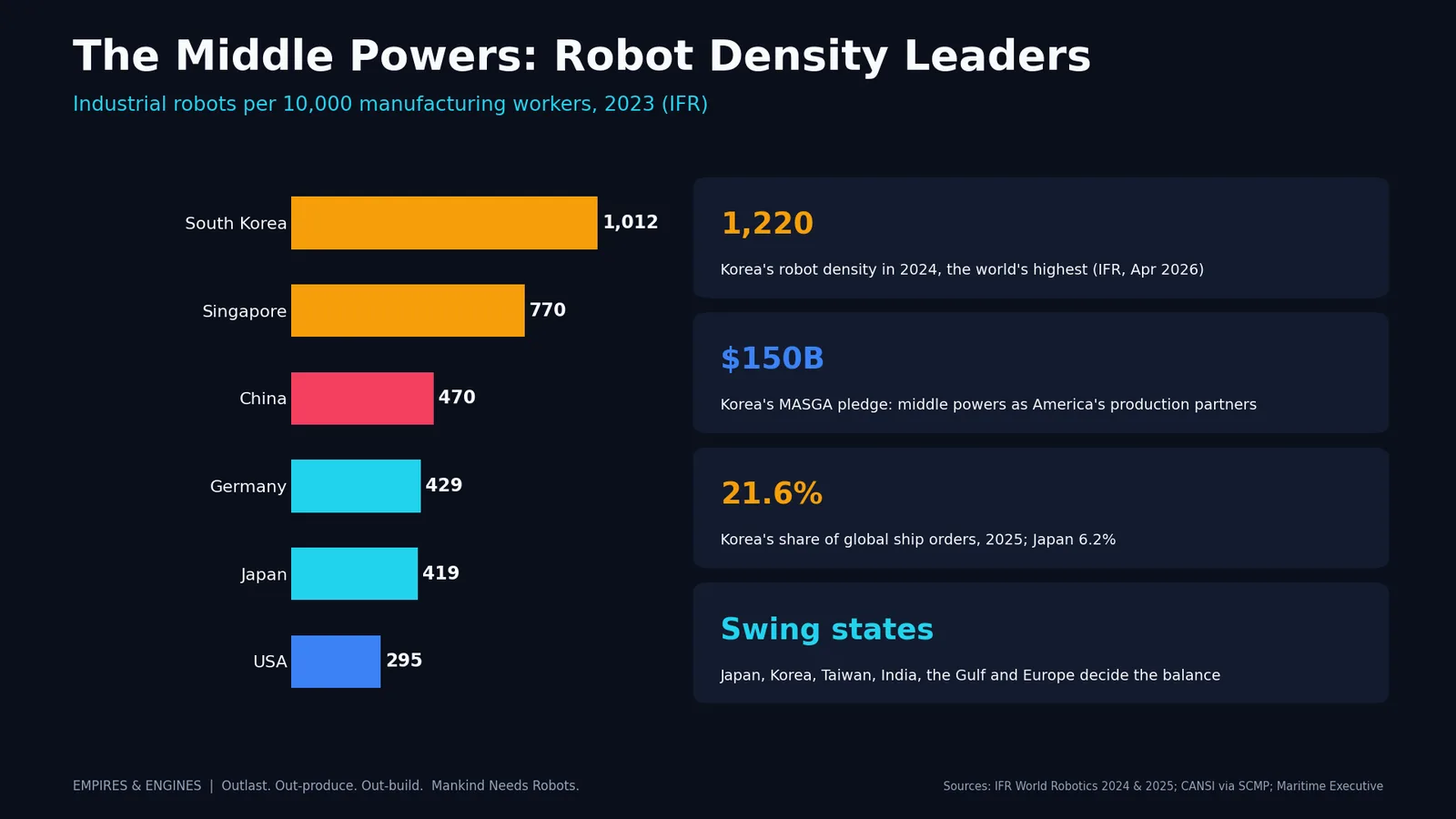
The race is usually framed as America against China, but Law 5 (alliances are balance-sheet leverage) says the outcome will depend on the countries in between. History supports this. The Delian League, the Anglo-Japanese Alliance and NATO each shifted the balance by adding other nations’ production to a leader’s own.
The most automated economies in the world are not the superpowers. The International Federation of Robotics reported that South Korea had 1,012 industrial robots per 10,000 manufacturing workers in 2023, followed by Singapore at 770, China at 470, Germany at 429 and Japan at 419, with the United States tenth at 295. By 2024, Korea’s density had risen to 1,220, the highest in the world.
These countries also hold critical positions in the supply chain. Japan and Germany make much of the world’s precision reducers, bearings, sensors and machine tools. South Korea builds ships, memory chips and batteries. Taiwan manufactures the leading-edge chips. Singapore is a financial and logistics hub. India, the Gulf states and Southeast Asia are the fastest-growing destinations for factories and data centers.
The United States is increasingly relying on these partners to fill its production gaps. South Korea’s pledge of up to US$150 billion to revive American shipbuilding is one example; TSMC’s Arizona fabs and Japanese and Korean investment in US battery and chip plants are others. China, meanwhile, courts middle powers with market access, infrastructure finance and cheap technology.
Lever Lesson: Neither superpower can out-produce the other alone across every pillar. The bloc that attracts Japan, Korea, Taiwan, Europe and India will have the deeper supply chain and the larger production base.
Thesis Link: Allies extend endurance. In an attrition contest, the coalition with the most factories wins, not the single strongest country.
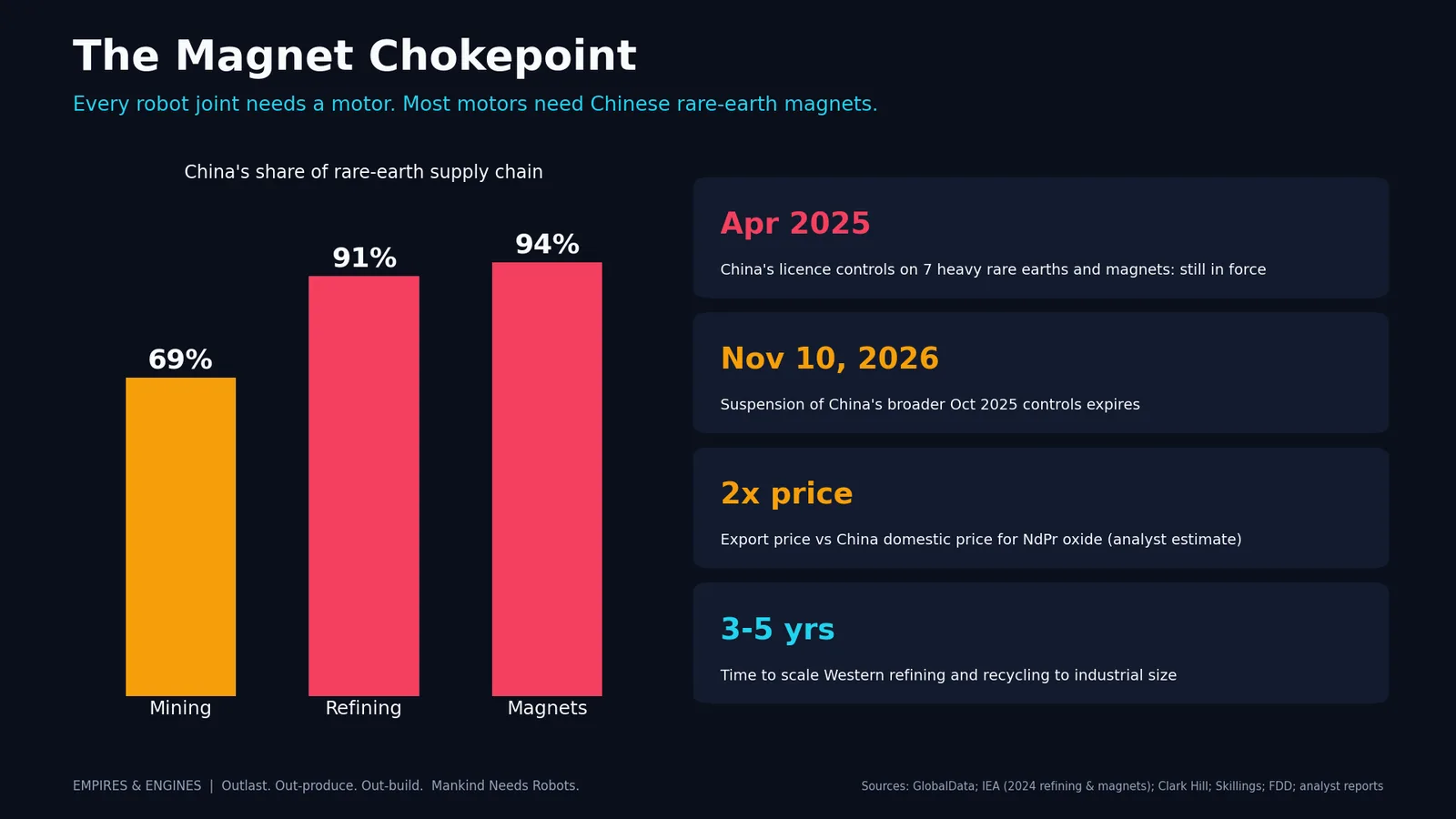
A humanoid robot moves through dozens of actuators, and most high-performance electric motors use permanent magnets made from rare-earth elements such as neodymium, praseodymium and dysprosium. First-principles thinking therefore leads straight to a mineral supply chain.
China dominates that chain at every stage. GlobalData estimated that China produced about 69 percent of global rare-earth mine output in 2025 and processes up to 90 percent of rare earths. The International Energy Agency estimated that China accounted for about 91 percent of refined magnet rare-earth output and roughly 94 percent of sintered permanent-magnet production in 2024.
China has used this position repeatedly, first in its 2010 restrictions on exports to Japan. In April 2025, amid the tariff escalation with the United States, China imposed licence requirements on seven medium and heavy rare earths and related magnets; those controls remain in force. In October 2025 Beijing announced a far broader package, including extraterritorial rules covering foreign products made with Chinese rare earths or technology. After US-China talks, China suspended that package in November 2025 for one year. The suspension is scheduled to expire on 10 November 2026, weeks after this paper’s date. Analysts expect partial or full reimposition to be at least as likely as full removal, although Beijing may also extend or selectively enforce the measures.
Western governments and companies are funding new mines, refineries, magnet plants and recycling. But building refining and magnet capacity at industrial scale typically takes three to five years, and announced projects historically slip. Industry analysts expect global demand for neodymium magnets to grow substantially by 2030, driven by electric vehicles, wind turbines, drones and robots.
Lever Lesson: This is Law 2 in its purest form. Every robot joint depends on an input one country controls. The magnet chokepoint may matter more to the humanoid race than any single AI breakthrough.
Thesis Link: The best supply chain wins attrition. For robots, the supply chain starts with magnets, and today China holds it.
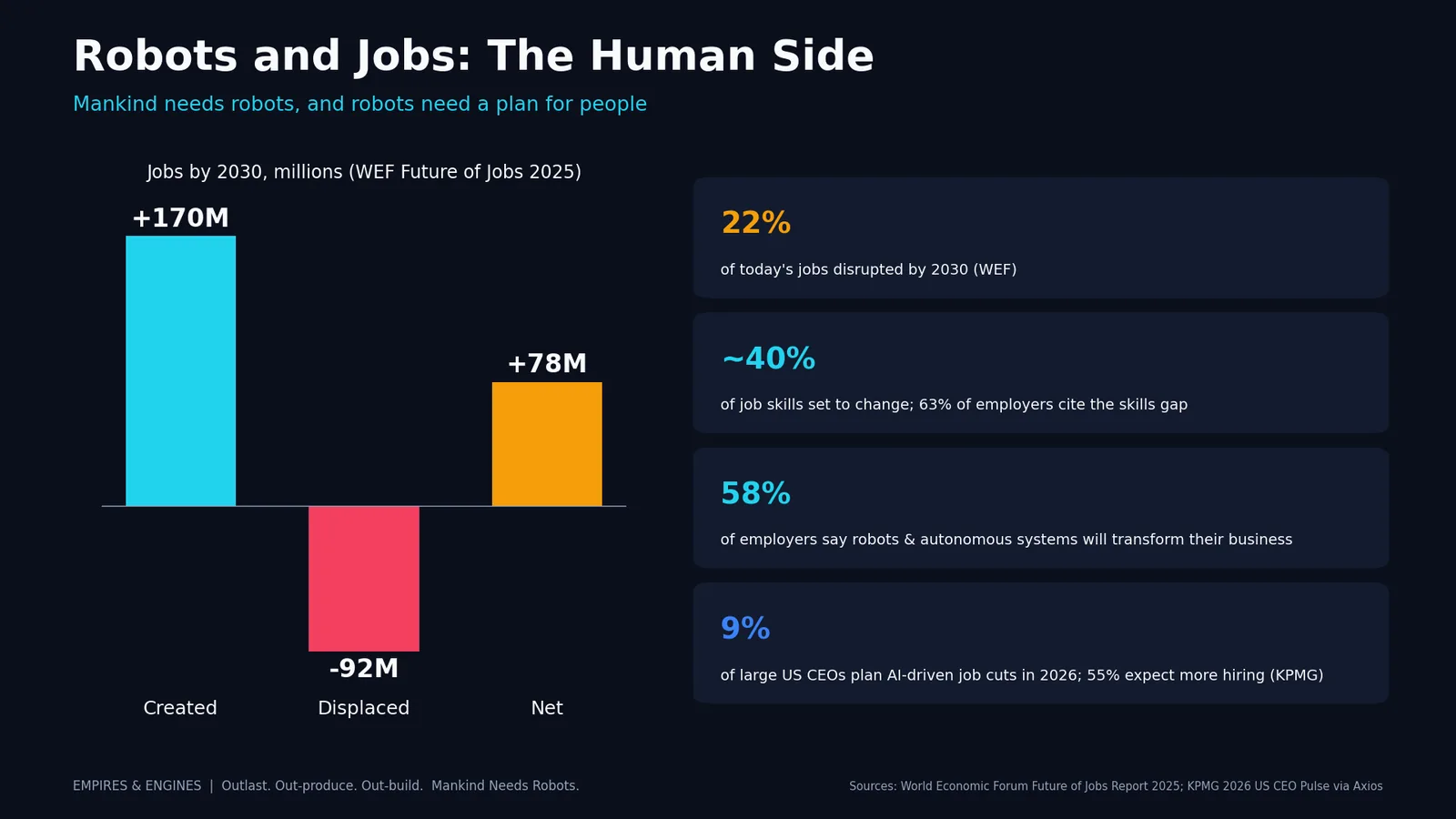
The attrition thesis holds that when people are the highest cost and a finite resource, the race to efficiency requires robots at scale. The obvious objection is: what happens to people? Answering it honestly makes the thesis stronger.
The World Economic Forum’s Future of Jobs Report 2025, based on a survey of more than 1,000 employers representing over 14 million workers, projected that technological, demographic and economic shifts would create about 170 million jobs and displace about 92 million by 2030, a net gain of about 78 million. It estimated that job disruption would equal about 22 percent of today’s jobs, that nearly 40 percent of required skills would change, and that 63 percent of employers see the skills gap as their main barrier. Employers named robots and autonomous systems among the leading drivers of change.
Early corporate behavior is similar. KPMG’s 2026 survey of large US companies found that only 9 percent of CEOs planned AI-driven workforce reductions that year, while 55 percent expected to increase hiring as a result of AI.
Every earlier wave of automation displaced specific jobs and regions while raising overall productivity and eventually employment. The handloom weavers displaced by power looms in the early nineteenth century suffered real hardship, and the Luddite protests of the 1810s were a rational response to that hardship. Over decades, industrialization created far more work than it destroyed, but the transition was painful and uneven. Janusian thinking holds both truths at once: robots can raise total prosperity and still devastate particular communities.
The nations that share the gains, through retraining, education, portable benefits and broad ownership of productive capital, will face less resistance and therefore adopt faster. Those that do not risk political backlash that slows deployment. Social cohesion is part of endurance.
Lever Lesson: Mankind needs robots, and robots need a plan for people. Aging societies facing labor shortages, including Japan, Korea, China and much of Europe, have the strongest reasons to embrace automation; the question is who designs the transition best.
Thesis Link: The efficiency race frees people for design, judgment, care and discovery, but only if the gains are broadly shared. Backlash is a supply-chain risk too.
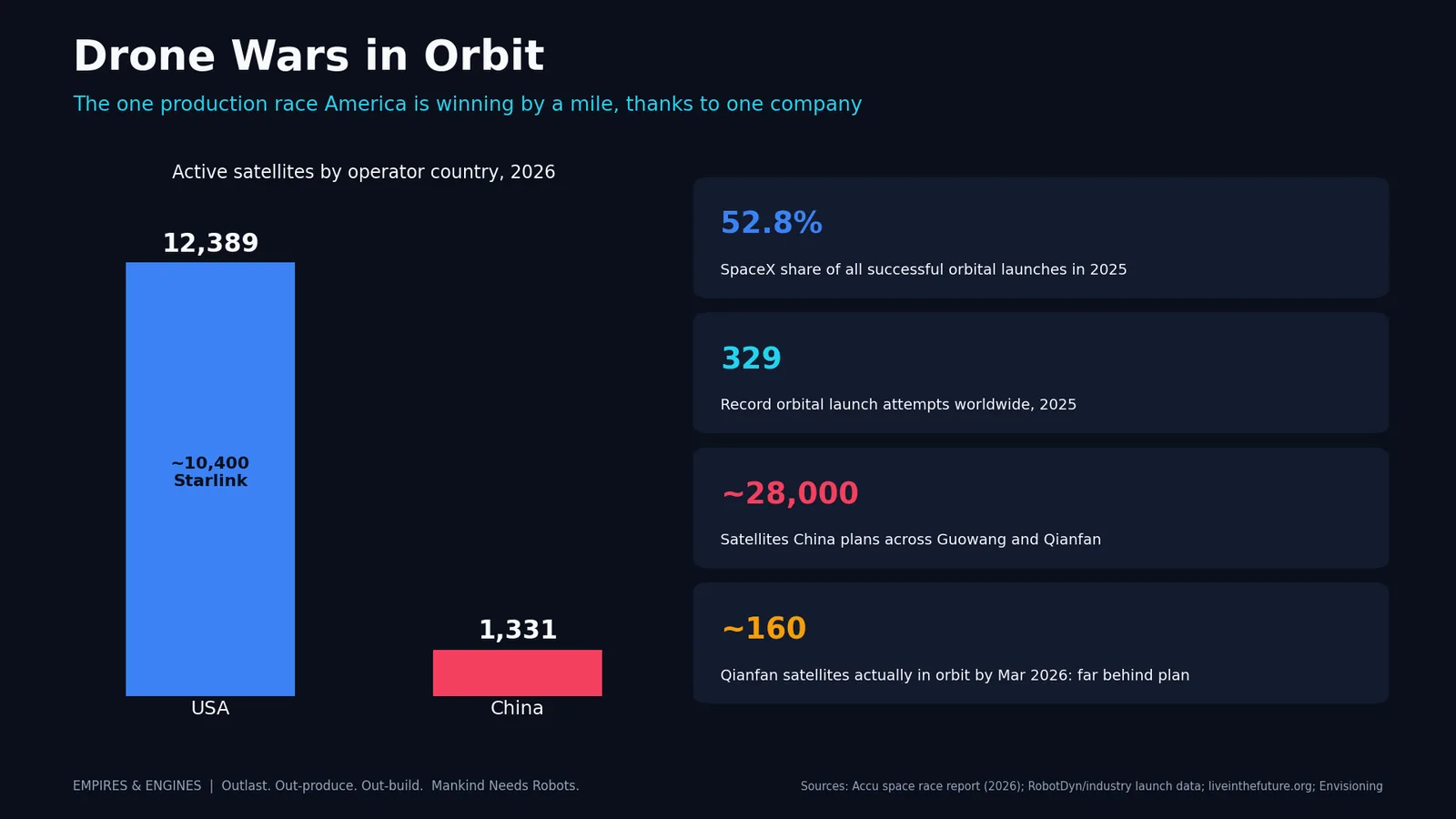
In space, the attrition thesis currently favors the United States, and the reason is production. In 2025, SpaceX conducted about 52.8 percent of all successful orbital launches worldwide, up from about 23 percent in 2021, according to an industry analysis. The world attempted a record 329 orbital launches that year. By 2026, the United States operated about 12,389 active satellites, roughly 10,400 of them SpaceX Starlink spacecraft, against about 1,331 for China.
Starlink provided resilient communications to Ukraine after Russia’s invasion, demonstrating that a private satellite constellation can become strategic infrastructure. Satellites underpin navigation, reconnaissance, communications and the command of drone fleets. Robot armies, autonomous ships and remote factories all depend on them.
China plans two mega-constellations, Guowang (about 13,000 satellites) and Qianfan (about 15,000). Progress has lagged: Qianfan had about 160 satellites in orbit by March 2026, far behind its schedule. China’s launch rate is rising quickly, however, and its state can direct resources over long periods.
Space shows that the United States can still dominate a production race when it combines private-sector speed, reusable technology and vertical integration. SpaceX builds its own rockets, engines and satellites and launches them at a cadence no competitor matches. That is exactly the formula the attrition thesis says wins: best supply chain, most efficient production, best technology, sustained over time.
Lever Lesson: America’s space lead is proof of concept. If the United States can apply the SpaceX model to ships, magnets, power and robots, it can compete in the production race. If it cannot, space may remain its lone manufacturing triumph.
Thesis Link: Drone wars already extend into orbit, and in orbit, the side that builds and launches the most is winning.
Empires & Engines works from one core thesis, stated by its founder:
“The winner at the end of the day is whoever can withstand attrition the longest and produce the most the longest, through having the best supply chain, the most efficient production capabilities and the best technology. And if humans are your highest cost of capital, since they are also one of your resources, then the race to efficiency necessitates a huge output of robotics: essentially drone wars in multiple capacities, whether in research, war, transportation or beyond. The future is now. We live in the future. Mankind needs robots.”
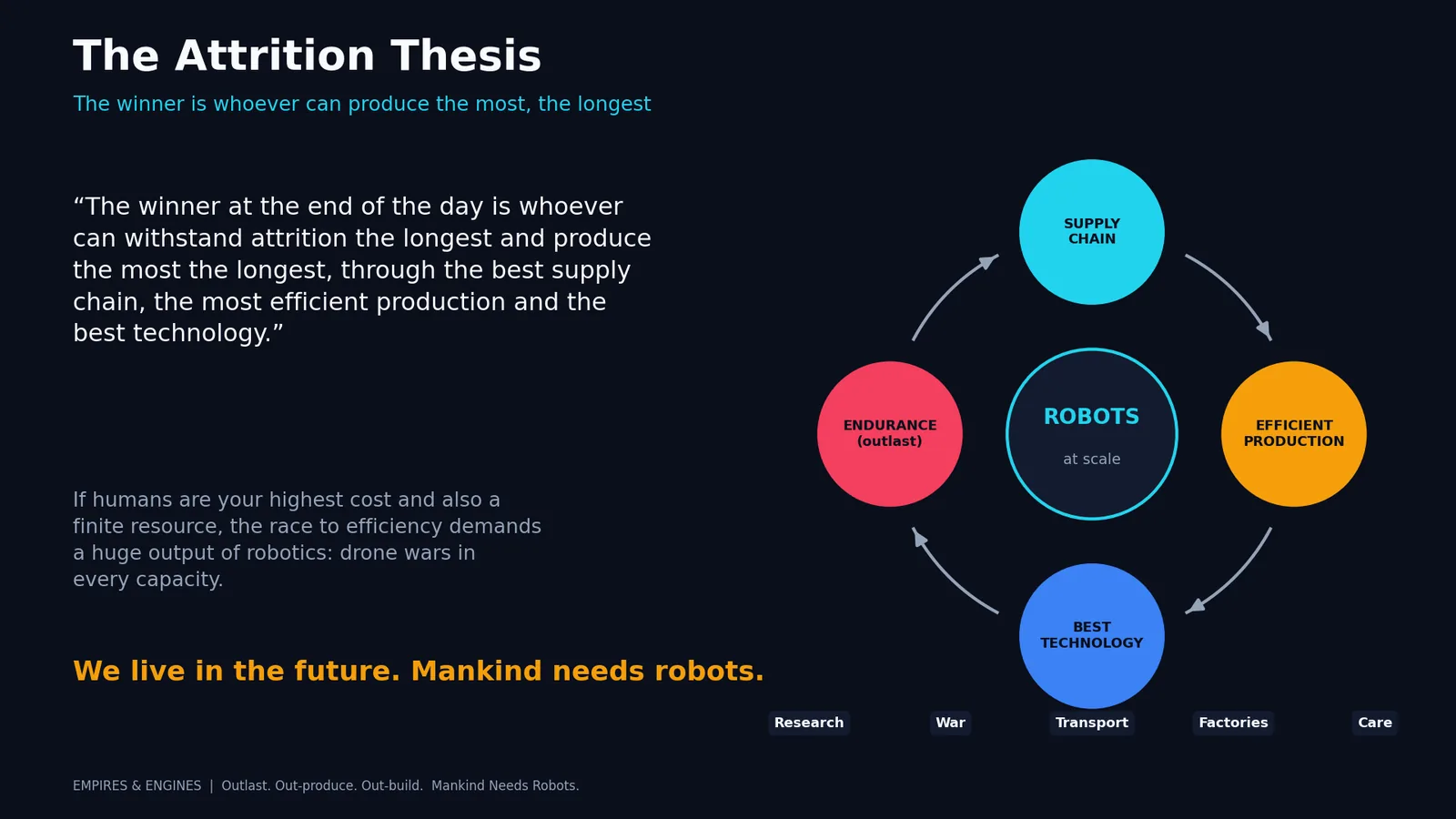
The thesis has three parts. First, competition between nations is ultimately a contest of endurance: the side that can keep producing longest wins. Second, endurance rests on three pillars, the supply chain, production efficiency and technology, and a nation needs all three. Third, because people are both the largest cost and a finite resource, the path to maximum sustained output runs through robots deployed at massive scale in every domain.
The case studies in Part II support the first claim repeatedly.
Rome outlasted Carthage. During the First Punic War, Rome lost entire fleets, including disasters to storms in 255 and 249 BC, and still rebuilt, funding at least one fleet through loans from wealthy citizens. Carthage, which began the war as the superior naval power, could not sustain the replacement rate. Rome won not because it had the best ships but because it could keep building them.
The Allies out-produced the Axis. Germany and Japan fielded technologically impressive weapons, but the United States built roughly 300,000 military aircraft during the war, and the combined Allied economies produced far more than the Axis. The Arsenal of Democracy was an attrition strategy.
The West outlasted the Soviet Union. The Soviet Union matched the United States in flagship technologies, but its economy could not sustain the arms race, the war in Afghanistan and the collapse in oil revenue. Endurance, not firepower, decided the Cold War.
Ukraine turned war into a production contest. Since 2022, mass-produced drones have become central to the fighting, and Ukrainian officials have described producing drones by the million each year. Chapter 16 examines this war in detail. The side that can manufacture cheap autonomous systems fastest, and keep doing so, gains the edge. This is the “drone war” of the thesis in its most literal form. Zelensky made the logic explicit at the UN General Assembly in September 2026: Ukraine’s target is not oil as such, but “Russia’s ability to finance this war, to drag it out.”
Supply chain. Morgan Stanley’s analysis, as reported in 2026, estimated that a humanoid built with a Chinese supply chain costs about US$46,000 versus about US$131,000 with non-Chinese components. China also dominates rare-earth magnet processing and battery supply. On this pillar, China leads.
Efficient production. China installed 54 percent of the world’s industrial robots in 2024 and shipped most of the world’s humanoids in 2025. The United States is responding (Tesla has converted its Fremont vehicle line to Optimus production) but starts far behind. On this pillar, China leads.
Best technology. The United States leads in private AI capital, frontier models, advanced chip design and data centers, though the Stanford AI Index measured the model gap at only 2.7 percent in March 2026. On this pillar, the United States leads narrowly.
By the thesis’s own logic, neither superpower yet holds all three pillars. The United States has the technology but not the production base; China has the production base and supply chain but depends on foreign chips and tools. The nation that closes its gap first gains the advantage in a long contest.
Labor is the single largest cost in most economies; in advanced economies, labor compensation typically accounts for roughly half or more of national income. Labor is also a finite and, in many countries, shrinking resource. Japan, South Korea, China and much of Europe face declining working-age populations. The United States faces a projected manufacturing labor shortfall of about 2.7 million workers by 2035, according to an Activant Capital analysis.
When the largest input is also the scarcest, the race to efficiency becomes a race to multiply output per person. Historically, that has meant machines: the water frame, the steam engine, the assembly line, the industrial robot. The thesis argues that the next step is a massive expansion of autonomous machines across every domain.
The thesis uses “drone wars” broadly, meaning competition decided by fleets of autonomous machines.
The paper’s critical-thinking discipline requires stating the best counterarguments.
Production does not always win. The United States out-produced North Vietnam and the Taliban by enormous margins and still failed to achieve its aims. Political will, legitimacy and local knowledge can outlast material superiority. The thesis is strongest in contests between comparable industrial powers.
Efficiency without distribution creates backlash. If robot-driven gains flow only to owners of capital, political resistance, from the Luddites of the 1810s to modern populism, can slow adoption. Endurance includes social cohesion.
Robots have their own supply chains. Robots do not escape attrition; they move it upstream to magnets, chips, batteries and electricity. A nation that automates without securing those inputs has replaced one vulnerability with another.
Humans remain the purpose. Treating people as a cost is a production-side lens. The deeper argument is that robots free people for design, judgment, care and discovery, work that machines complement rather than replace.
These objections refine the thesis rather than refute it. The refined version: among comparable powers, the winner is the one that sustains the highest output longest, and in the twenty-first century that requires secure supply chains for robots themselves, broad sharing of the gains, and deployment at a scale no human workforce could match.
Every era in this paper rewarded the nation that could keep producing when others ran out: of ships, of soldiers, of money, of coal, of chips. The coming era will reward the nation that can keep producing robots. Outlast. Out-produce. Out-build. The future is now. We live in the future. Mankind needs robots.
| Date | Event | Primary levers |
|---|---|---|
| c. 3200 BC | Cuneiform writing develops in Uruk for accounting | Information, technology |
| c. 1754 BC | Code of Hammurabi publicly displayed | Law |
| c. 1200-1150 BC | Late Bronze Age collapse of interconnected palace economies | Trade, resources |
| 7th c. BC | Lydia mints first coins | Finance |
| c. 550 BC | Cyrus founds Achaemenid Persian Empire | Diplomacy, law |
| c. 500 BC | Persian Royal Road links Sardis and Susa | Technology, information |
| 483 BC | Laurion silver strike; Athens builds trireme fleet | Resources, military |
| 480 BC | Battle of Salamis | Military |
| 478 BC | Delian League founded | Alliances, finance |
| c. 432 BC | Megarian Decree bars Megara from Athenian markets | Trade (offensive) |
| 359-336 BC | Philip II reforms Macedonian army and uses bribery | Military, finance, intelligence |
| c. 300 BC | Arthashastra’s mandala theory of alliances | Diplomacy, alliances |
| 264-241 BC | First Punic War; Rome copies Carthaginian ships | Technology, military |
| 221 BC | Qin unifies China and standardizes script, weights, axles | Law and standards |
| 138 BC | Zhang Qian’s mission west seeks allies against the Xiongnu | Alliances, diplomacy |
| 117 BC | Han salt and iron monopolies | Industrial policy |
| 81 BC | Discourses on Salt and Iron debate | Industrial policy |
| 146 BC | Rome destroys Carthage | Military (offensive) |
| 30 BC | Rome annexes Egypt and its grain | Resources |
| 212 AD | Caracalla extends Roman citizenship | Law, finance |
| 3rd c. AD | Roman currency debasement crisis | Finance (failure) |
| c. 552 | Silkworm eggs smuggled to Byzantium | Intelligence, technology |
| 670s | Byzantine Greek fire breaks Arab sieges | Technology, military |
| 751 | Battle of Talas; papermaking spreads west | Technology |
| 1005 | Treaty of Chanyuan: Song pays Liao for peace | Diplomacy, finance |
| 1204 | Venice diverts Fourth Crusade to Constantinople | Military, trade |
| 1206 | Genghis Khan founds Mongol Empire | Military, talent |
| 1284 | Hanseatic embargo forces Norway to concede | Trade (offensive) |
| 1370 | Treaty of Stralsund favors Hanseatic League | Trade, diplomacy |
| 1405-1433 | Zheng He’s treasure fleet voyages | Technology, diplomacy |
| 1453 | Ottomans take Constantinople with massive cannon | Technology, talent |
| 1474 | Venetian patent statute | Law |
| 1488-1498 | Portuguese round Africa and reach India | Technology |
| 1494 | Treaty of Tordesillas divides the world | Diplomacy |
| 1510-1515 | Portugal seizes Goa, Malacca and Hormuz | Military, resources |
| 1545 | Potosí silver discovered | Resources |
| 1602 | Dutch East India Company chartered | Finance, trade |
| 1609 | Bank of Amsterdam founded | Finance |
| 1624 | English Statute of Monopolies | Law |
| 1651 | English Navigation Acts | Law, trade (offensive) |
| 1685 | Revocation of Edict of Nantes; Huguenot exodus | Talent (failure) |
| 1694 | Bank of England founded | Finance |
| 1714 | British Longitude Act prize | Technology, industrial policy |
| 1789 | Samuel Slater carries textile technology to America | Talent, intelligence |
| 1791 | Hamilton’s Report on Manufactures | Industrial policy |
| 1803 | Louisiana Purchase | Finance, diplomacy |
| 1834 | German Zollverein launched | Trade, alliances |
| 1839-1842 | First Opium War; Treaty of Nanking | Trade, military |
| 1843 | Britain lifts machinery export restrictions | Technology |
| 1862 | US Morrill Land-Grant Act | Talent |
| 1868 | Meiji Restoration | Industrial policy |
| 1871-1873 | Iwakura Mission | Intelligence, talent |
| 1884-1885 | Berlin Conference | Diplomacy |
| 1902 | All Red Line cable network completed; Anglo-Japanese Alliance | Information, alliances |
| 1909-1913 | Haber-Bosch process developed and scaled | Technology, resources |
| 1914 | Britain cuts German cables; blockade begins | Information, trade (offensive) |
| 1917 | Zimmermann Telegram decoded | Intelligence |
| 1940 | Tizard Mission shares cavity magnetron with US | Alliances, technology |
| 1941 | Lend-Lease; US oil embargo on Japan | Finance, resources |
| 1944 | Bretton Woods conference | Finance, law |
| 1945 | Manhattan Project; Operation Paperclip begins | Technology, talent |
| 1948 | Marshall Plan | Finance, alliances |
| 1949 | NATO; COCOM export controls; Soviet atomic test | Alliances, technology |
| 1957-1958 | Sputnik; ARPA and NASA founded | Technology, industrial policy |
| 1973 | Arab oil embargo; Taiwan founds ITRI | Resources; industrial policy |
| 1978 | Deng Xiaoping’s reforms begin | Industrial policy, trade |
| 1985 | Plaza Accord | Finance |
| 1986-1987 | US-Japan Semiconductor Agreement; SEMATECH; TSMC founded | Trade, industrial policy |
| 1991 | Soviet Union dissolves | Failure (overextension) |
| 2001 | China joins WTO | Trade |
| 2013 | Belt and Road Initiative | Finance, diplomacy |
| 2015 | Made in China 2025 | Industrial policy |
| 2017 | China’s New Generation AI Development Plan | Industrial policy |
| 2019 | Huawei added to US Entity List | Law (offensive) |
| 2022 | CHIPS and Science Act; US advanced-chip export controls; ChatGPT; sanctions on Russia | Industrial policy, technology, finance |
| 2022 | Russia invades Ukraine; Moskva sunk by Ukrainian missiles | Military, technology |
| 2025 | Operation Spiderweb drone strike on Russian bomber bases | Technology, intelligence |
| 2025 | DeepSeek-R1; China ships most of world’s humanoids; Figure valued at US$39B | Technology, scale |
| 2025 | China adds ~540 GW of power capacity; wins 69% of global ship orders | Resources, industrial policy |
| 2025 | ‘Justice Mission 2025’ PLA blockade drills around Taiwan | Military |
| 2025 | China imposes licence controls on heavy rare earths and magnets (April) | Resources (offensive) |
| 2025 | SpaceX flies over half of the world’s orbital launches | Technology, production |
| 2026 | Strait of Hormuz closure; Brent peaks near US$126 | Resources (offensive) |
| 2026 | Ukraine’s refinery campaign drives Russian refining to a 21-year low | Resources (offensive), technology |
| 2026 | China’s 15th Five-Year Plan names embodied intelligence a future industry; Tesla converts Fremont line to Optimus | Industrial policy, scale |
The matrix rates how central each lever was to the leading powers of each era (High, Medium, Low), based on the case studies in Part II.
| Lever | Ancient | Medieval | Early modern | Industrial | World wars | Cold War | 2000s-2026 |
|---|---|---|---|---|---|---|---|
| Technology | Medium | High | High | High | High | High | High |
| Military | High | High | High | High | High | High | Medium |
| Trade | Medium | High | High | High | Medium | Medium | High |
| Finance | Medium | Medium | High | High | High | High | High |
| Diplomacy | High | High | High | High | Medium | High | Medium |
| Alliances | High | Medium | Medium | Medium | High | High | High |
| Intelligence | Medium | High | Medium | Medium | High | High | High |
| Information | Medium | Medium | Medium | High | High | High | High |
| Law and standards | High | Medium | High | Medium | Medium | Medium | High |
| Talent | Medium | High | High | High | High | High | High |
| Resources | High | Medium | High | High | High | High | High |
| Industrial policy | Medium | Medium | High | High | High | High | High |
Actuator: A device that produces motion in a robot, typically an electric motor combined with a gearbox or screw.
Chokepoint: A narrow point in a supply chain or trade route through which a large share of activity must pass, giving its controller leverage.
COCOM: The Coordinating Committee for Multilateral Export Controls (1949 to 1994), through which Western allies restricted strategic exports to the Soviet bloc.
Embodied intelligence / physical AI: AI systems that perceive, reason and act in the physical world through a body such as a robot or vehicle.
Entity List: A US Commerce Department list of foreign parties subject to export restrictions.
Export controls: Government restrictions on the sale of goods, software or technology to foreign parties.
Fiscal-military state: A state whose military power rests on efficient taxation and public borrowing, exemplified by eighteenth-century Britain.
Foundation model: A large AI model trained on broad data that can be adapted to many tasks.
Humanoid robot: A robot with a human-like form, typically including a torso, arms and legs or a wheeled base, designed to operate in human environments.
Industrial policy: Government action to shape the structure of the economy by supporting particular industries.
Mandala theory: Kautilya’s theory that neighboring states are natural rivals and the neighbors of neighbors natural allies.
Resource curse: The tendency of economies with abundant natural-resource revenue to underperform in productive development.
Robot-as-a-Service (RaaS): A business model in which customers pay a recurring fee to use robots rather than buying them.
Total addressable market (TAM): The total revenue opportunity available for a product or service.
Vision-language-action (VLA) model: An AI model that links visual perception and language understanding to robot actions.
History says the side that out-produces for longest wins. We track who's doing it, every month.
Empires & Engines, "The Nation as Enterprise: The Attrition Thesis," Version 1.0, September 2026. https://empiresandengines.com/research/nation-as-enterprise/Press and corrections: press@empiresandengines.com